5 HIIT Formats Built Around a Single Bench
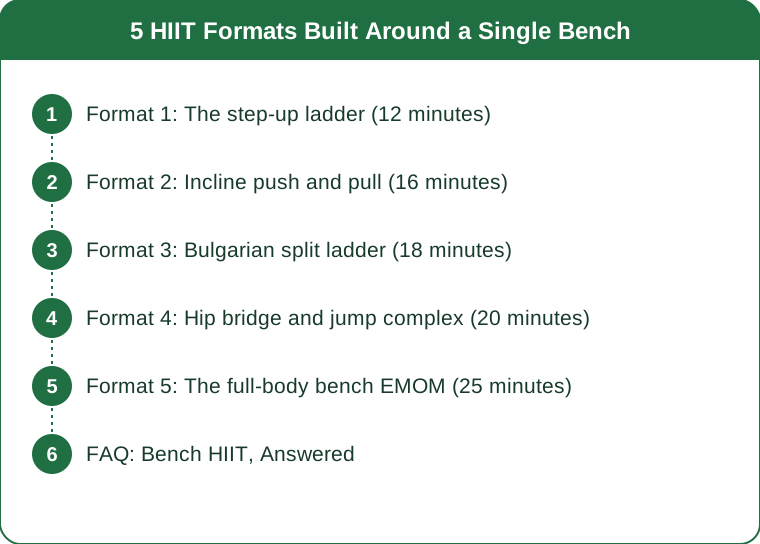
Quick Answer: A bench gives you height for step-ups, an incline for pressing, a raised surface for hip work, and a support for split-stance movements - which covers every movement pattern an interval session needs. These five formats run 12 to 25 minutes each: a step-up ladder, an incline push and pull, a Bulgarian split ladder, a hip bridge and jump complex, and a full-body EMOM. Pick one, run it twice a week, and swap when it stops feeling hard.
One bench. That is the entire equipment list.
Here are five formats that use it differently, in order from most accessible to most demanding.

Format 1: The step-up ladder (12 minutes)
The structure: step-ups, alternating legs, in a descending ladder. Six minutes of work in two blocks.
Round one is 40 seconds of work and 20 seconds rest. Round two is 35 and 25. Round three is 30 and 30, and rounds four through six repeat the pattern. Run six rounds, rest two minutes, and run the whole thing again.
Why it works: step-ups are a large-muscle, low-skill movement that raises heart rate quickly without much impact, which makes them a good interval driver for people whose joints do not love jumping.
Technique that matters: drive through the heel of the foot on the bench and stand fully upright at the top. Pushing off the back foot turns it into a calf exercise and removes most of the value.
Bench height changes the difficulty enormously. A knee-height bench is considerably harder than a lower step. Start lower than you think and progress the height rather than the speed.
Progression: hold a weight in each hand, or slow the lowering to two seconds. Both are better progressions than moving faster, which mostly degrades form.
Suits: beginners, anyone returning after a break, and days when you want the cardiovascular effect without impact.
Format 2: Incline push and pull (16 minutes)
The structure: four exercises, 40 seconds each, 20 seconds transition, four rounds. Incline push-ups with hands on the bench, bench-supported single-arm rows if you have any weight or a bag, decline push-ups with feet on the bench, and bench dips.
Why it works: it pairs pushing and pulling in the same interval block, which lets each pattern recover while the other works - so you get more total quality volume than four rounds of the same movement.
Incline push-ups are the regression, decline are the progression, and having both in the same session means you can adjust difficulty mid-workout by moving your hands or feet rather than stopping.
Bench dips need a caution: keep your elbows tracking straight back and do not drop below ninety degrees at the shoulder. If you feel it in the front of the shoulder rather than the back of the arm, raise your range.
No weight for the rows? Use a backpack loaded with books, or substitute an inverted row under a sturdy table.
Progression: add a round, or slow the lowering phase on the push-ups to three seconds. Tempo is a better progression than speed for upper body intervals.
Suits: upper-body-focused interval days and hotel or home training with minimal equipment.
Format 3: Bulgarian split ladder (18 minutes)
The structure: rear-foot-elevated split squats with the back foot on the bench. Work one leg for 30 seconds, switch immediately, then rest 30 seconds. That is one round. Run eight rounds, rest two minutes, run six more.
Why it works: single-leg work produces a large metabolic demand from a small amount of load, and the unilateral pattern exposes and corrects the side-to-side differences that bilateral training hides.
Foot position decides which muscle takes the load. Further forward loads the glute more; closer to the bench loads the quad and demands more ankle mobility. Pick deliberately rather than by accident.
Balance is the limiter for most people at first, not strength. Hold a wall or a rack with one hand for the first few sessions - it lets you actually train the legs rather than practising balance.
Keep the back knee soft and the front shin roughly vertical to slightly forward. Depth matters less than control, and half a good range beats a full sloppy one.
Progression: hold weight, add rounds, or pause for two seconds at the bottom. The pause is the most humbling and the most useful.
Suits: leg days, runners and cyclists correcting imbalances, and anyone who wants a demanding session in a very small space.

Format 4: Hip bridge and jump complex (20 minutes)
The structure: a two-movement complex repeated. Shoulders-elevated hip thrusts on the bench for 40 seconds, then bench jumps or fast step-ups for 20 seconds, then 40 seconds rest. Run ten rounds.
Why it works: it pairs a slow hip extension movement with an explosive one, which trains the same pattern at two very different speeds and produces a strong cardiovascular response from the contrast.
Shoulders-elevated hip thrusts are the most underrated bench exercise. Rest your upper back on the bench, feet flat, and drive the hips up to a straight line from knee to shoulder. Squeeze at the top rather than arching the lower back.
Bench jumps require honest judgement about height. Use a low, absolutely stable surface and step down rather than jumping down - the landing is where injuries happen, not the take-off.
If jumping is not appropriate, fast step-ups produce most of the same effect with none of the landing risk. This is a substitution rather than a compromise.
Progression: hold weight across the hips on the thrusts, or increase jump height by a small increment. Never both in the same session.
Suits: glute-focused interval days and anyone wanting power work inside a conditioning session.
Format 5: The full-body bench EMOM (25 minutes)
The structure: every minute on the minute, five movements on rotation, five rounds. Minute one is 12 step-ups, minute two is 10 incline push-ups, minute three is 12 split squats total, minute four is 15 hip thrusts, minute five is 30 seconds of a bench plank. Rest whatever remains in each minute.
Why it works: the EMOM format self-regulates. Move efficiently and you earn rest; move slowly and the workout gets harder automatically - which keeps the session honest without a coach.
Set the rep numbers so you finish each minute with 15 to 20 seconds spare in round one. If you are finishing with no rest by round two, the numbers are too high and the session will fall apart by round four.
Adjust the numbers rather than abandoning the round. Dropping from 12 step-ups to 10 in the later rounds is a legitimate adjustment, not a failure of the workout.
The bench plank is the recovery minute, and it should feel like one. If it does not, the preceding four minutes were too heavy.
Progression: add one rep to each movement, or add a sixth round. Adding reps is the smoother progression of the two.
Suits: full-body conditioning days, limited time, and anyone who prefers a fixed clock to a rep-based structure.
As outdoor temperatures start dropping, this format works well on a park bench too - the fixed clock keeps you moving enough to stay warm, which is more than can be said for a rest-based structure in cool air.
FAQ: Bench HIIT, Answered
Can you get a real HIIT workout with just a bench?
Yes. A bench provides height, incline, decline, and support, which covers pushing, pulling, single-leg, hip hinge, and plyometric patterns - everything an interval session needs.
How high should the bench be for step-ups?
Start below knee height and progress upward. Height changes the difficulty more than speed does, and a bench that is too high forces you to push off the back foot, which removes most of the benefit.
Are bench dips safe?
For most people, with elbows tracking straight back and no dropping below ninety degrees at the shoulder. If you feel it in the front of the shoulder, reduce the range or substitute another pressing movement.
How many of these should I do per week?
Two interval sessions a week is plenty alongside other training. Pick one format, run it twice, and swap when it stops feeling demanding.
What if I cannot jump?
Substitute fast step-ups. They produce most of the cardiovascular effect with none of the landing load, and the swap is a genuine equivalent rather than an easier option.
How do I set the EMOM rep numbers?
So you finish round one with 15 to 20 seconds of rest in each minute. If there is no rest left by round two, the numbers are too high for the session to hold together.
TL;DR:
- A bench covers push, pull, single-leg, hinge, and plyometric patterns - enough for a complete interval session.
- Format 1 (step-up ladder) is the low-impact entry point; format 3 (split squat ladder) is the most demanding for the least space.
- Drive through the heel on step-ups and stand fully upright; pushing off the back foot removes the benefit.
- Set EMOM rep numbers so round one leaves 15 to 20 seconds of rest per minute.
- Substitute fast step-ups for any jump - it is an equivalent, not an easier option.
Two sessions a week, one format at a time, swap when it stops feeling hard.
Keep Reading
This article is for general informational and styling purposes only. Fit, sizing, and product availability may vary.