5 HIIT Formats for When You Have No Space and No Equipment
Quick Answer: Effective HIIT needs a high enough effort and enough recovery to repeat it — not space or equipment. Five formats below cover the useful range: 30/30 for beginners, Tabata for time-crunched sessions, EMOM for structure, ladders for progression, and a low-impact format for shared floors. All fit a two-metre square.
The two things that stop most home HIIT sessions are floor space and downstairs neighbours. Neither is actually a requirement of interval training — they are a requirement of the exercises people default to.
Here are five formats, each with a full structure, movement list, and the specific thing it is good for.
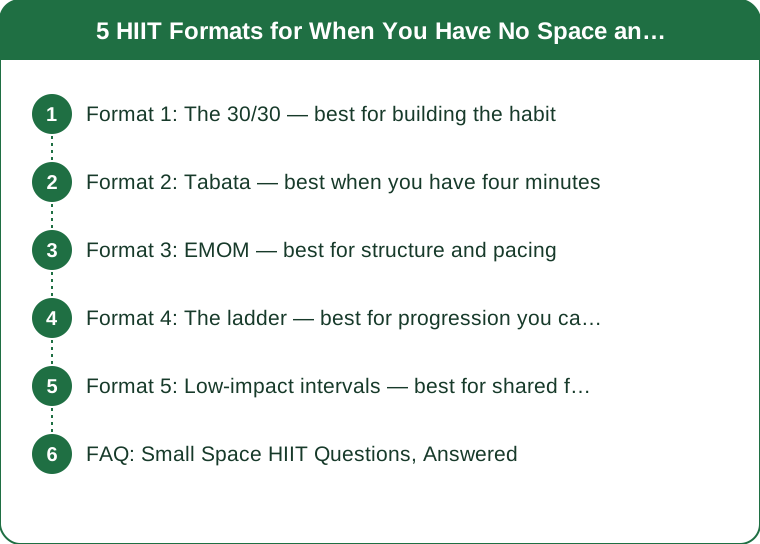
Format 1: The 30/30 — best for building the habit
Structure: 30 seconds of work, 30 seconds of rest, 8 to 12 rounds. Total time: 8 to 12 minutes plus a warm-up.
This is the most forgiving true HIIT format and the right starting point for anyone new to intervals. A 1:1 work-to-rest ratio gives enough recovery to keep the work intervals genuinely hard, which is the whole point — intervals that degrade into moderate continuous effort are not intervals.
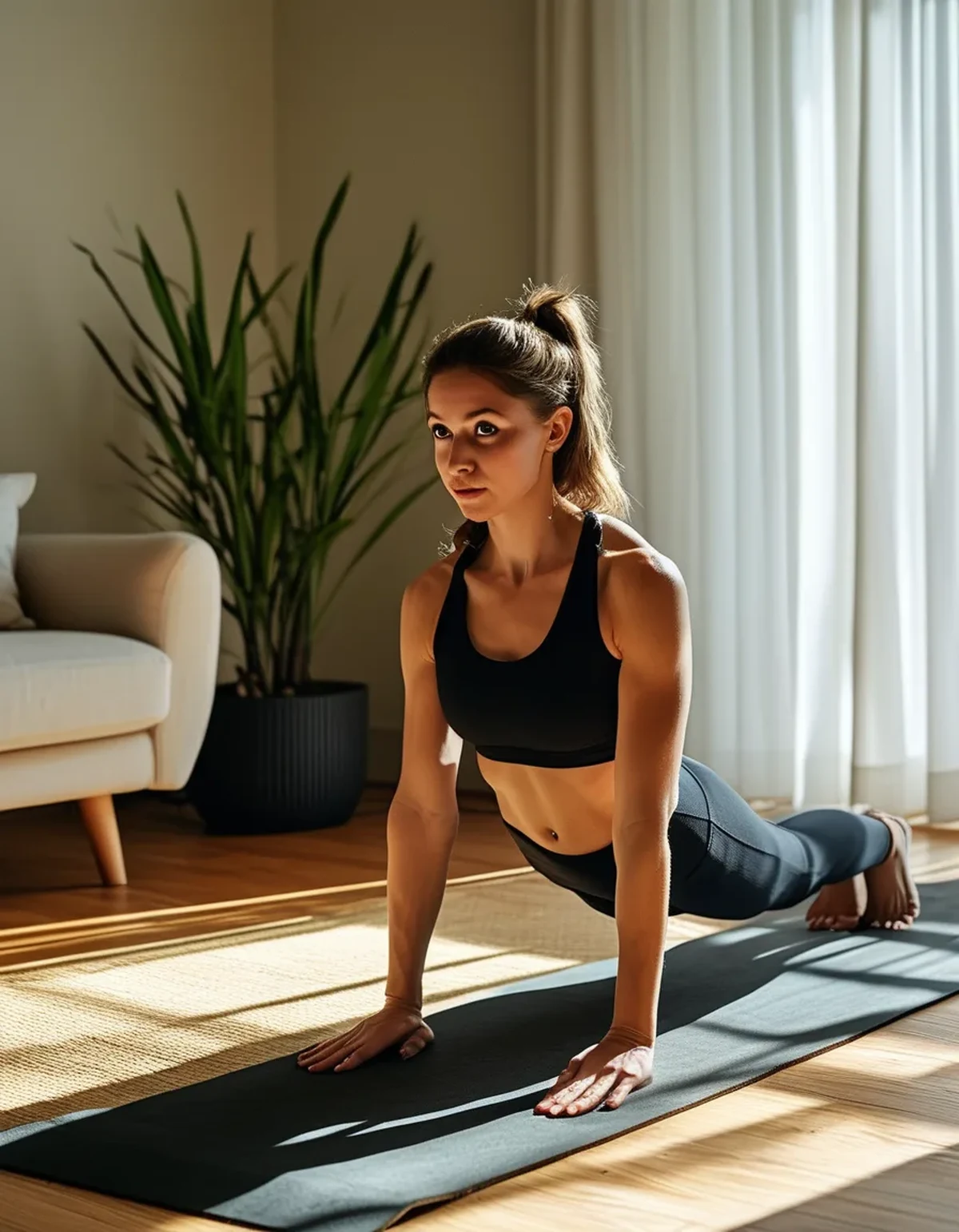
Movements, rotating through: squat to stand, reverse lunge alternating, push-up (hands elevated on a sofa or wall if needed), mountain climber, glute bridge with a pause, plank shoulder tap.
How hard should the work be? You should be able to complete the last round at roughly the same quality as the first. If round eight is visibly worse than round two, the work intervals were too hard, not the format.
Space needed: the length of your body plus half a metre. Difficulty dial: shift to 40/20 to make it harder, 20/40 to make it easier, before adding rounds.
Best for: two to three sessions a week when you are establishing consistency, or as a re-entry point after time off.
Format 2: Tabata — best when you have four minutes
Structure: 20 seconds maximum effort, 10 seconds rest, 8 rounds. Total: 4 minutes of work.
Tabata is the most misused format in fitness. The original protocol used a single exercise at an intensity around 170 percent of VO2 max — genuinely maximal, to the point that participants could not complete the eighth round. A Tabata done at moderate effort with six different exercises is a circuit, not a Tabata, and it produces circuit-level results.
Done properly, it uses one movement, at genuinely maximal effort, for all eight rounds. Suitable options in a small space: squat jumps, high knees, burpees, or — for a low-impact version — fast bodyweight squats or a hard isometric wall sit alternated with squat pulses.
Expect round five to be miserable. That is the format working. If round eight looks like round one, you did not go hard enough for it to be Tabata.
Space needed: one metre square. Difficulty dial: the movement choice is the dial. Do not add rounds; four minutes is the design.
Best for: the days you have almost no time, done once or twice a week at most. It is a high-cost stimulus and does not need to be frequent.
Format 3: EMOM — best for structure and pacing
Structure: Every Minute On the Minute. At the top of each minute, perform a set number of reps; whatever time remains is your rest. Run 10 to 20 minutes.
EMOM is the format that teaches pacing, because the rest is self-earned. Work faster and you rest longer; work sloppily and you run out of minute.
A sample 12-minute EMOM in a small space, alternating each minute:
- Minute 1: 12 squats
- Minute 2: 8 push-ups
- Minute 3: 20 alternating reverse lunges
- Repeat four times.
Choose rep numbers that take roughly 30 to 40 seconds. If a minute takes you 50 seconds, the rep count is too high and the session becomes continuous work.
Space needed: two metres square. Difficulty dial: add two reps per movement, not extra minutes, until minutes take 45 seconds — then add minutes.
Best for: people who find open-ended intervals hard to pace, and for sessions where you want a predictable, repeatable benchmark. The same EMOM run monthly is a good progress test.

Format 4: The ladder — best for progression you can feel
Structure: reps climb then descend. For example: 1 push-up, 2 squats; 2 push-ups, 4 squats; 3 and 6; up to 6 and 12, then back down. Rest as needed only at the turn.
Ladders solve the motivation problem of intervals by giving you a visible arc. The first rungs feel trivially easy, which functions as a warm-up; the top rungs are genuinely hard; the descent is where the work accumulates because you are tired and the reps are dropping more slowly than your capacity.
Pairings that work in small spaces: push-up and squat, reverse lunge and plank shoulder tap, glute bridge and mountain climber.
Timing: an ascending-descending ladder to six typically runs 10 to 14 minutes. Set a cap rather than a target and stop at the cap wherever you are.
Space needed: body length plus half a metre. Difficulty dial: extend the top rung by one, or reduce rest at the turn.
Best for: sessions where you want the work to feel like a game rather than a countdown, and for training partners of different fitness levels — each runs their own ladder, same clock.
Format 5: Low-impact intervals — best for shared floors
Structure: 40 seconds work, 20 seconds rest, 10 to 15 rounds, using exclusively non-jumping movements.
The assumption that HIIT requires jumping is the reason so many people give it up in flats. Intensity comes from effort and muscle recruitment, not from leaving the ground. A hard set of squat pulses raises heart rate every bit as effectively as jumping jacks and makes no noise at all.
Movement list, all silent: bodyweight squats at speed, reverse lunges (step back, do not hop), incline push-ups, plank walk-outs, glute bridge with a two-second hold, standing knee drives, wall sit with alternating heel raises, bear-crawl holds with shoulder taps.
Making it hard enough: slow the eccentric portion, add an isometric pause, or reduce the rest before adding rounds. A three-second lowering phase on a squat is dramatically harder than a fast one and generates no impact.
Space needed: one and a half metres square. Difficulty dial: rest interval first, then tempo, then rounds.
Best for: apartments, early mornings, late evenings, anyone with joint concerns, and anyone returning to training after a lower-limb injury. It is the format most people should be using most of the time.
Choosing between them
Use 30/30 while building consistency, low-impact for most weeks, EMOM when you want a benchmark, ladders when you are bored, and Tabata rarely and only when you mean it.
FAQ: Small Space HIIT Questions, Answered
How many HIIT sessions a week is sensible?
Two to three for most people, with easier or different training on other days. HIIT is a high-cost stimulus and the common mistake is doing it five times a week at 70 percent effort, which delivers neither the intensity benefit nor adequate recovery.
Do I need to warm up for a four-minute session?
Yes, and more so than for a longer one, because there is no gradual build. Five minutes of progressively faster easy movement — marching, squats, arm circles, a few slow lunges — substantially reduces injury risk and improves the quality of the first round.
Is bodyweight HIIT enough to build strength?
It builds strength effectively at first and then plateaus, because bodyweight load is fixed and progressive overload has to come from tempo, leverage, and unilateral variations. Those tools carry most people a long way, but if strength is a primary goal you will eventually want external resistance. As a conditioning stimulus, though, bodyweight intervals remain effective indefinitely.
TL;DR:
- Intensity comes from effort, not from space or equipment — five complete formats fit a two-metre square.
- 30/30 builds the habit, Tabata is four genuinely maximal minutes, EMOM teaches pacing, ladders add progression, low-impact protects shared floors.
- Adjust rest interval and tempo before adding rounds.
- Two to three HIIT sessions a week is the useful range; more usually means each one is too easy.
The version of interval training that requires a garage and a rower is one version. The one that fits between a sofa and a coffee table works about as well, and it happens considerably more often.
Keep Reading
This article is for general informational and styling purposes only. Fit, sizing, and product availability may vary.