5 HIIT Formats for a Shared Apartment Gym
Quick Answer: A shared building gym has three constraints that break normal HIIT programming: you cannot monopolize equipment, you cannot make much noise, and you often cannot count on any single machine being free. The formats that work are ones built around one piece of equipment or none, in a fixed footprint, with a defined end time. All five below run in 20 minutes or less, need at most two dumbbells and a bench, and can be abandoned and resumed if someone needs the machine.
The building gym is a real training resource and most people underuse it because the constraints do not fit anything they have read.
These five formats are designed backwards from those constraints rather than adapted to them.

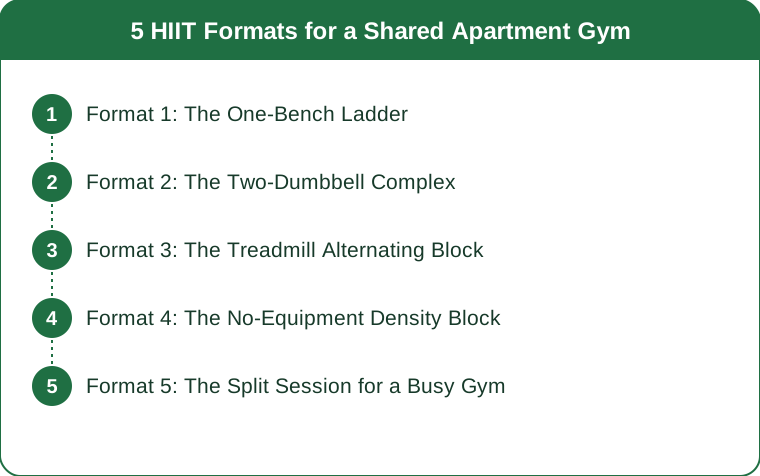
Format 1: The One-Bench Ladder
Equipment: a bench. Footprint: the bench and one body length. Time: 16 minutes.
This is the format for when every machine is taken and the free weight area is busy. It uses one bench and nothing else, and it stays entirely within its own footprint - no travel, no equipment sharing, no waiting.
The structure is an ascending then descending ladder. Four movements, performed for 20 seconds each with 10 seconds transition, cycling for four rounds, then repeating the block with the reps climbing.
The four movements: elevated push-ups with hands on the bench, bench step-ups alternating legs, feet-elevated mountain climbers, and bench-supported split squats. Every one of them is quiet - no jumping, no dropping, no impact through the floor.
Why it works as a HIIT stimulus: the movements alternate between upper push, single-leg lower, core and single-leg again, which means no single muscle group limits the session before your cardiovascular system does. That is the actual requirement for an interval workout to be an interval workout - the limiting factor should be your ability to recover, not local muscular fatigue.
Scaling: make the work interval 30 seconds and the transition 15 for a harder version, or drop to 15 and 15 if the bench height is making the step-ups too demanding. The bench height matters more than people expect - a higher bench makes step-ups significantly harder and push-ups significantly easier.
Format 2: The Two-Dumbbell Complex
Equipment: one pair of dumbbells. Footprint: a mat’s worth of floor. Time: 15 minutes.
A complex is a sequence of movements performed back to back without putting the weight down. It is the most equipment-efficient interval format there is, because one pair of moderate dumbbells becomes an entire session and nobody else is waiting on it.
The sequence: 6 romanian deadlifts, 6 bent rows, 6 hang cleans, 6 front squats, 6 push presses. Complete all thirty reps without setting the dumbbells down, then rest 90 seconds. Five rounds.
Weight selection is the whole game. Choose based on the weakest movement in the sequence, which for most people is the push press. A weight you could press for twelve reps fresh is roughly right - it will feel far too light for the deadlift and exactly right by round three.
Why it suits a shared gym: you take one pair of dumbbells for fifteen minutes and use nothing else. No machine, no bench, no rack. If someone needs those specific dumbbells, you can finish the round and hand them over - the format degrades gracefully in a way a program built around a squat rack does not.
The noise profile is good as long as you control the eccentric and do not drop the weights at the end of a round. Set them down deliberately. In a building gym below someone’s living room, that matters more than the workout does.

Format 3: The Treadmill Alternating Block
Equipment: one treadmill. Footprint: the treadmill. Time: 20 minutes.
Most building gyms have one or two treadmills and an unspoken twenty or thirty minute limit. This format is built to use exactly that window and leave.
The structure: 4 minute warm-up at an easy walk or jog. Then 8 rounds of 45 seconds hard and 45 seconds easy. Then 4 minutes easy to finish.
Use incline rather than speed for the hard intervals. This is the key adaptation for a shared space. Incline intervals produce a comparable cardiovascular stimulus with far less noise and far less belt impact, and they are considerably safer on an unfamiliar machine. A 45 second interval at 8 to 12 percent incline at a brisk walk is genuinely hard.
Set the incline before the interval starts, not during. Treadmill incline motors take several seconds to travel, and an interval spent waiting for the deck to reach position is a wasted interval.
Why incline over speed in a building gym: running at speed on a treadmill directly above someone’s ceiling is the single most complained-about gym behavior in residential buildings. Incline walking at high effort solves the noise problem entirely while still producing the interval stimulus.
Scaling: raise the incline rather than the speed as you get fitter. Most treadmills go to 12 or 15 percent, which is a very long runway.
Format 4: The No-Equipment Density Block
Equipment: none. Footprint: a mat. Time: 12 minutes.
For when the gym is full, or when you have twelve minutes between things, or when the only free space is the corner by the water cooler.
Set a 12 minute timer and complete as many rounds as possible of: 10 squats, 8 push-ups, 12 reverse lunges alternating, 20 second plank hold.
Density training is HIIT with the rest self-selected. You go, you rest when you need to, and the score is total rounds. This makes it unusually well suited to a shared space because you can pause without breaking the workout - if someone needs to get past, you have not ruined a prescribed interval structure.
Every movement is low-noise and low-impact. No jumping, which is both a neighbor consideration and a joint consideration if you are training on the concrete slab that most building gyms are built on.
Record the round count. The progression is beating it, not adding weight or complexity. Density scores are one of the cleanest progress metrics in bodyweight training because the variable is genuinely single-dimensional.
Common mistake: going out too hard in the first three minutes and spending minutes four through twelve recovering. The best scores come from a sustainable pace with short frequent rests, not from an all-out start.
Format 5: The Split Session for a Busy Gym
Equipment: whatever is free. Footprint: variable. Time: 18 minutes.
This is less a workout than a strategy, and it is the one that makes a busy building gym usable at peak hours.
The structure: three 6 minute blocks, each built around whatever equipment is available when you get to it. Block one is lower body, block two is upper body, block three is cardio or full body. Within each block, work 40 seconds and rest 20, for six rounds.
The point is that you commit to a block, not to a machine. If the bench is free, block two is dumbbell presses and rows. If it is not, block two is push-ups and a band row. You decide in the thirty seconds before the block starts, based on what is actually available.
Why this beats a fixed program in a shared space: the most common reason people abandon a building gym workout is that the equipment their program requires is occupied. A format that treats equipment as a variable never gets abandoned.
Keep a short list on your phone of two options per block - one that needs equipment and one that does not. Decide by looking around, not by planning ahead.
And accept a lower ceiling in exchange for consistency. A building gym session is not going to be your best workout of the week. It is going to be the one that happens on the day when nothing else would have. That trade is almost always worth taking, and consistency across a season beats any individual session.
TL;DR:
- Build around one piece of equipment or none - programs that need a specific machine get abandoned when it is occupied.
- The one-bench ladder and two-dumbbell complex each need a single item and produce a full interval stimulus.
- Use treadmill incline instead of speed - same cardiovascular cost, far less noise through a residential ceiling.
- Density blocks pause gracefully, which matters when you are sharing a small room.
- The split session treats equipment as a variable, so the workout survives a busy gym.
- No jumping. Concrete slabs and neighbors below both vote against it.
The building gym will not produce your best session of the week. It will produce the one that happens anyway.
Keep Reading
This article is for general informational and styling purposes only. Fit, sizing, and product availability may vary.