5 HIIT Formats for the First Weeks of Darker Mornings
Quick Answer: Dark mornings shorten the practical window and lengthen the warm-up you actually need. These five formats all run in 20 minutes or less indoors, need little or no equipment, and front-load the warm-up so a cold body is not asked to sprint in minute one. Pick one per week rather than rotating daily — familiarity is what makes a 6am session happen at all.
This is general information, not medical advice.

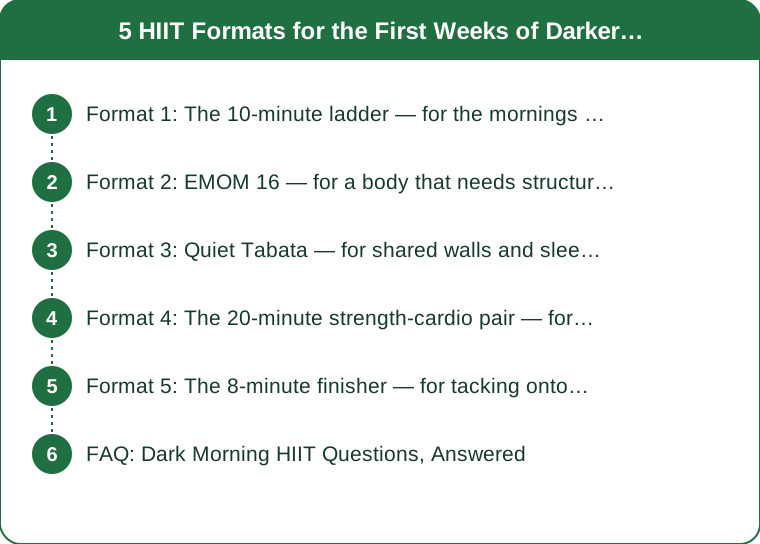
Format 1: The 10-minute ladder — for the mornings you almost skipped
Structure: 20 seconds work, 40 seconds easy, for three rounds; then 30 on, 30 off for three rounds; then 40 on, 20 off for three rounds. Ten minutes total including the ramp.
Why it suits a dark morning: it starts at the lowest intensity and builds, which is exactly what a cold, stiff body needs. There is no maximal effort until minute five.
Movement choices: squat to stand, step-back lunge, and a low-impact knee drive. All quiet, all floor-friendly.
The point of this one is attendance, not stimulus. Ten minutes that happen beats twenty-five that do not, and the ladder structure means even an abandoned session gave you the warm-up.
Progression: add a fourth round to each block rather than increasing the work interval.
Format 2: EMOM 16 — for a body that needs structure to wake up
Structure: every minute on the minute for 16 minutes, alternating two movements. Roughly 30 to 40 seconds of work, the rest as rest.
Why it suits a dark morning: the clock does the deciding. There is no judgement required at 6am about whether to keep going, which is the main reason early sessions fail.
Movement choices: 10 goblet squats on odd minutes, 8 push-ups on even minutes. One dumbbell or kettlebell covers it.
Scale by reps, not by time. If you cannot finish inside 40 seconds, reduce the reps rather than extending the minute.
Progression: add reps to one movement per week, alternating which one.
Format 3: Quiet Tabata — for shared walls and sleeping households
Structure: 20 seconds on, 10 seconds off, eight rounds, per block. Two blocks with three minutes between them. Roughly 12 minutes plus warm-up.
Why it suits a dark morning: it is short and it can be done entirely without impact, which matters at 6am in a flat.
Movement choices: wall sit pulses, slow mountain climbers, glute bridge holds with a march, and a controlled squat. No jumping anywhere.
Add a genuine four-minute warm-up. Tabata is a maximal-effort protocol and going into it cold is the single most common way people hurt themselves with it.
Progression: increase range of motion and control before increasing speed. Quiet formats reward tempo work.

Format 4: The 20-minute strength-cardio pair — for the day after a lifting session
Structure: five rounds of 40 seconds work and 20 seconds rest across four movements, alternating a lower-body strength movement with a cardio movement.
Why it suits a dark morning: the strength intervals give genuine recovery from the cardio ones without stopping, so the session stays warm in a cold room.
Movement choices: split squats, fast step-ups, single-arm rows, and a low-impact shuffle.
Keep the strength intervals sub-maximal. This is a conditioning session with strength movements in it, not a strength session.
Progression: hold the format and add load, which is the cleanest way to progress a session you do weekly.
Format 5: The 8-minute finisher — for tacking onto whatever else you did
Structure: four rounds of 40 seconds hard and 80 seconds easy, one movement throughout.
Why it suits a dark morning: it attaches to a walk, a commute, or a short strength session, so it does not need its own warm-up or its own decision.
Movement choices: one only — bike, rower, stairs, or fast step-ups. Repetition is the point.
The long recovery is deliberate. An 80-second recovery allows genuinely hard work intervals, which is where the adaptation actually comes from.
Progression: increase the intensity of the work interval, not its length. If you can hold the same effort for 50 seconds, the 40 was too easy.
Late-summer note: as mornings cool, allow an extra two to three minutes of warm-up before any of these. A body that has been in a cold room all night takes longer to be ready than one that has not.
FAQ: Dark Morning HIIT Questions, Answered
How many of these a week?
Two to three genuine HIIT sessions a week is plenty for most people alongside other training. More than that and the quality of each falls.
Is a short warm-up really necessary for 10 minutes of work?
More necessary, not less. Short sessions tempt people to start at high intensity immediately, and cold-morning starts are where most avoidable strains happen.
Can I do these fasted?
Many people manage short morning sessions comfortably without eating. If you feel lightheaded or the quality drops noticeably, a small carbohydrate snack beforehand is a reasonable change. Anyone managing blood sugar should follow medical guidance rather than general advice.
TL;DR:
- Dark mornings need front-loaded warm-ups and formats that decide for you.
- The ladder builds intensity gradually; EMOM removes decisions; quiet Tabata protects neighbours.
- Strength-cardio pairs keep you warm in a cold room; finishers attach to something else.
- Pick one format per week — familiarity is what makes early sessions happen.
- Two to three genuine HIIT sessions weekly is enough alongside other training.
The best format in October is the one you do not have to think about at 6am.
This is general information, not medical advice.
Keep Reading
This article is for general informational and styling purposes only. Fit, sizing, and product availability may vary.