5 HIIT Formats Built Around a Single Kettlebell
Quick Answer: A single kettlebell covers every HIIT demand if you change the interval structure instead of the load. Use 30 on 30 off for pure conditioning, EMOM for controlled volume, ladders for progressive fatigue, complexes for grip and full-body demand, and density blocks for measurable progress. A moderate bell, 8 to 16kg for most women, works across all five because the format supplies the intensity.
The usual problem with one piece of equipment is not the equipment. It is that people keep doing the same workout with it and then decide they need a second one.
A kettlebell is unusually well suited to interval work because it lets you shift from hinge to press to carry without ever setting anything down. Change how you slice the time and the same bell becomes five different workouts.

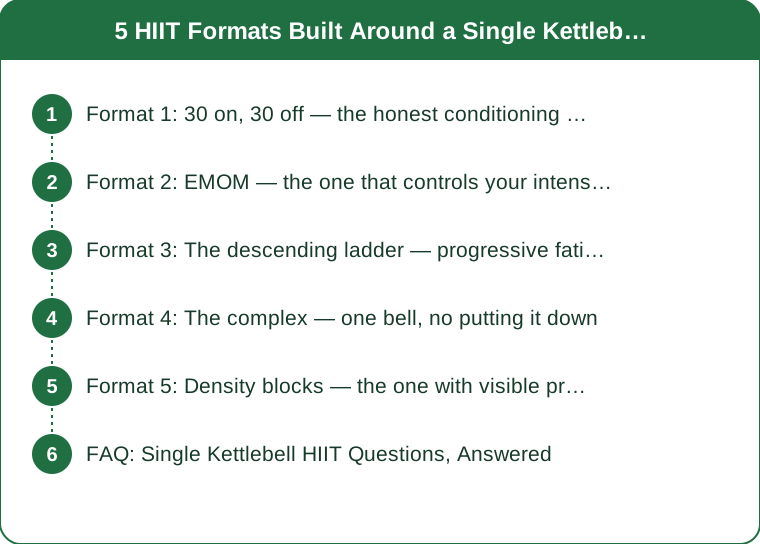
Format 1: 30 on, 30 off — the honest conditioning block
The simplest structure and the one most people underuse because it looks too basic on paper.
Structure: 30 seconds of work, 30 seconds of rest, alternating two movements, for 20 total rounds. Ten minutes of work inside twenty minutes of clock.
Pairing: kettlebell swings and goblet squats. Swings load the posterior chain and drive heart rate. Goblet squats keep the legs working while the arms partially recover.
Why it works: the 1 to 1 ratio is long enough to accumulate real fatigue and short enough that form does not collapse. Most people find rounds 1 through 6 comfortable, rounds 7 through 13 genuinely hard, and rounds 14 through 20 a test of whether they paced correctly.
How to know you picked the right weight: you should complete round 18 with the same technique as round 3. If your swing is turning into a squat by round 12, the bell is too heavy for this format, not too heavy in general.
Start with a bell you could swing 25 times unbroken when fresh. That is usually 12 to 16kg for a woman with some training background, 8 to 12kg starting out.
Format 2: EMOM — the one that controls your intensity for you
Every Minute On the Minute. The clock starts, you do the prescribed reps, and whatever time is left is your rest.
Structure: 16 minutes, alternating minutes.
- Odd minutes: 15 kettlebell swings
- Even minutes: 8 goblet squats plus 4 push-ups
Why it works: EMOM is self-regulating in a way interval timers are not. Move efficiently and you earn 25 seconds of rest. Move sloppily and you earn 10. The format punishes wasted motion instead of punishing you.
The thing nobody mentions: EMOM is the best format for training on a day when you are not sure how you feel. The structure caps your intensity. You cannot accidentally turn it into a max effort, because the rep count is fixed.
Setting the reps correctly: choose numbers that take you 30 to 40 seconds at a controlled pace. If you are finishing in 20 seconds, add reps. If you are finishing in 50, cut them. Getting this dialed takes one session and then it is set for weeks.
Format 3: The descending ladder — progressive fatigue management
Reps drop as fatigue climbs, which keeps quality high through the whole set.
Structure: one continuous block, minimal rest, working down.
- 10 swings, 10 goblet squats, 10 rows per side
- 8 of each
- 6 of each
- 4 of each
- 2 of each
Rest only as needed. Most people take 20 to 30 seconds between rungs on the first two and less as the numbers drop. Total time usually lands between 8 and 14 minutes.
Why it works: the highest rep counts happen while you are freshest, and the set shrinks as you tire. That inverse relationship is why ladders feel achievable while still accumulating serious volume, 90 reps of each movement in this example.
The mental side is the real feature. Every rung is shorter than the last. There is always a visible end, which is why people finish ladders they would have quit out of a fixed-rep format.
Format 4: The complex — one bell, no putting it down
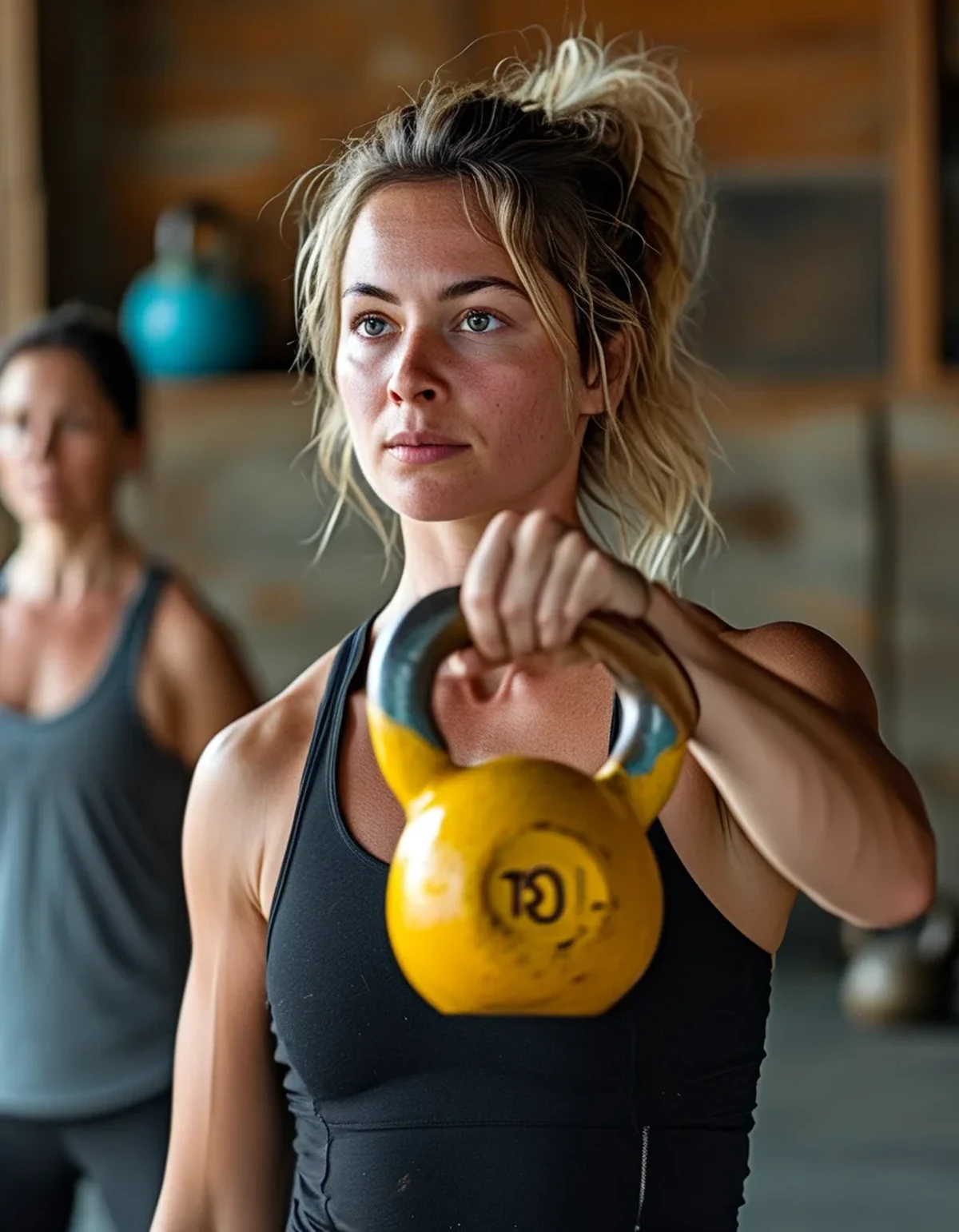
A complex is a fixed sequence of movements performed without releasing the bell. It is the format that reveals grip endurance, and grip is usually the limiting factor nobody trained.
Structure: 5 rounds, resting 90 seconds between. All on one side, then switch.
- 5 single-arm swings
- 5 cleans
- 5 presses
- 5 front-rack reverse lunges
- 5 single-arm rows
That is 25 reps per side per round without setting the bell down.
Why it works: the sequence forces the bell through every position, so shoulder stability, hip drive, and trunk control all get worked in one continuous demand. And because you cannot rest your grip, forearm endurance becomes the honest ceiling.
Weight selection matters more here than anywhere else. Choose based on the press, which is the weakest link. If you can strict press it 8 times fresh, you can complete this complex. Most people go 4 to 8kg lighter than their swing weight, which feels wrong for the first two movements and correct by the third.
Format 5: Density blocks — the one with visible progress
Fixed time, count total reps, try to beat the number next time. This is the format that solves the biggest problem with single-equipment training, which is that progress becomes invisible when you cannot add weight.
Structure: three 5-minute blocks with 2 minutes of rest between.
- Block A: alternating swings and push-ups, 10 and 5, as many rounds as possible
- Block B: goblet squats and rows, 8 and 8 per side, as many rounds as possible
- Block C: swings only, count total reps, break as needed
Write down all three numbers. That is your baseline.
Why it works: you cannot add load, so you add work per unit time. A 12 percent improvement in block C across six weeks is a real conditioning gain, and it is a number instead of a feeling.
How to progress it: run the same three blocks every two weeks. When your totals improve by more than 15 percent, that is when a heavier bell becomes worth buying, not before.
A seasonal note: these five formats all work indoors in a small space, which matters as the outdoor training window narrows through fall. If your conditioning has lived outside all summer, having one bell and five structures is what keeps it from disappearing in November.
This is general information, not medical advice. If you are new to kettlebell training, get the swing hinge assessed by a qualified coach before adding intensity.
FAQ: Single Kettlebell HIIT Questions, Answered
What weight kettlebell should I start with?
For most women with some training background, 12 to 16kg handles swings and 8 to 12kg handles presses and complexes. If you can only buy one, pick the middle of that range and adjust the format rather than the load.
How many times a week can I do kettlebell HIIT?
Two to three sessions with at least a day between works for most people. Swings load the posterior chain hard, and the soreness pattern is closer to strength training than to cardio.
Is one kettlebell really enough?
For conditioning, yes, indefinitely. For maximal strength, no. The five formats here change the demand rather than the load, which covers conditioning well but eventually plateaus for pure strength.
TL;DR:
- 30 on, 30 off for straightforward conditioning with a 1 to 1 ratio.
- EMOM when you want the format to cap your intensity for you.
- Descending ladders to accumulate volume while quality stays high.
- Complexes to expose and train grip endurance, using a lighter bell chosen by your press.
- Density blocks to make progress measurable when you cannot add weight.
One bell, five structures, and the intensity comes from how you slice the clock rather than from what you are holding.
Keep Reading
This article is for general informational and styling purposes only. Fit, sizing, and product availability may vary.