5 HIIT Formats Built for Cooler Outdoor Training
Quick Answer: Cooler weather makes outdoor HIIT better in almost every way — you can push harder without heat limiting you, and recovery between intervals is faster. The two things that change: you need a warm-up two to three times longer than in summer, and passive standing rest becomes a problem because you cool down fast. These five formats are built around active recovery, continuous movement, and short setup.
High-intensity work in 85°F was a compromise. Every interval was limited by how much heat you could shed, not by how hard you could work.
At 55°F, that ceiling lifts. What replaces it is a different set of constraints — and formats designed for summer handle them badly.

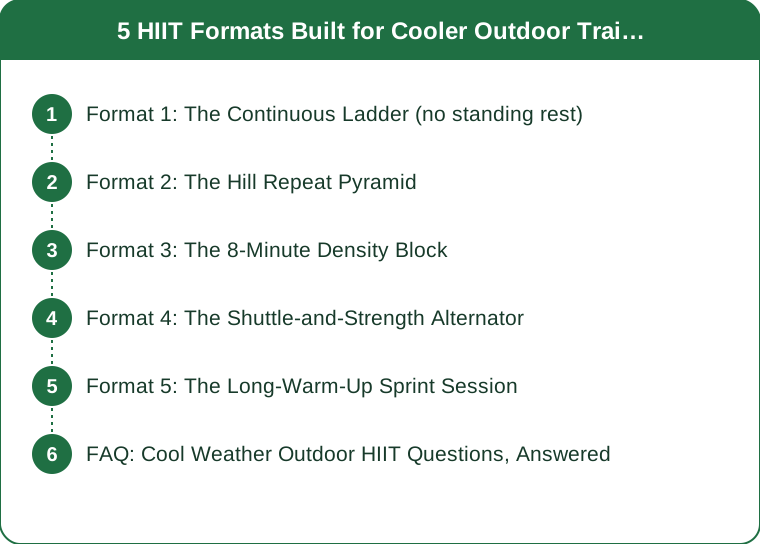
Format 1: The Continuous Ladder (no standing rest)
Structure: 30 seconds work, 30 seconds brisk walk or jog, escalating through five movements, three rounds. About 18 minutes.
The movements: squat jumps, mountain climbers, alternating reverse lunges, burpees, and high knees. Between every single interval, you keep moving — a brisk walk, an easy jog on the spot, or a slow shuttle back and forth.
Why it suits cool weather: standing still for 30 seconds in 50°F air drops your muscle temperature meaningfully, and the next interval starts colder, stiffer, and with a higher injury risk. Active recovery keeps blood flowing and body temperature stable, and it costs you very little in terms of interval quality.
The ladder structure adds a mental hook. Each round you know exactly what’s coming, and the movements progress from lower to higher demand, which means your last interval of each round is the hardest one — a natural finish point.
Scaling it: beginners drop to two rounds and swap burpees for squat thrusts without the jump. Advanced athletes extend work to 40 seconds and keep recovery at 30.
Equipment: none. This is the format for a park, a driveway, or a stretch of empty path, and it needs no setup at all — which matters when you’re standing outside in the cold deciding whether to bother.
Format 2: The Hill Repeat Pyramid
Structure: find a hill taking 20 to 60 seconds to climb. Run 20s, walk down. Then 30s, 40s, 50s, 40s, 30s, 20s. About 20 minutes with recovery.
Recovery is the walk down, which is exactly the active recovery cool weather calls for. You never stop moving, and the descent is gentle enough to be genuine recovery.
Hills are the safest form of high intensity in cool weather. The uphill running motion reduces impact forces compared to flat sprinting, and the reduced ground contact speed makes hamstring strain — the classic cold-weather sprint injury — far less likely.
The pyramid structure means you peak in the middle, when you’re fully warm, and descend as fatigue accumulates. This is a better fatigue distribution than a flat set of identical intervals, especially in conditions where your first effort is compromised by cold.
Effort guide: the 20-second efforts should be near maximal, the 50-second effort strong but sustainable. If you’re slowing dramatically on the descent side of the pyramid, the climbs were too hard on the way up.
Adaptation: no hill available? Stairs work, a treadmill incline works, and a parking garage ramp works surprisingly well and is sheltered from wind.
Format 3: The 8-Minute Density Block
Structure: pick three movements. Do 8, 6, and 4 reps of them in sequence, as many rounds as possible in 8 minutes. Rest 2 minutes. Repeat with three different movements.
Why density formats suit the cold: there’s no scheduled rest, so you never stand still long enough to cool down. You self-regulate by slowing down rather than stopping, which keeps core temperature up.
Block one: 8 push-ups, 6 jump squats, 4 burpees. Block two: 8 alternating lunges per side, 6 mountain climber pairs, 4 tuck jumps.
Descending rep counts are the trick. Starting with the highest count on the easiest movement and finishing with the lowest on the hardest means every round ends with a short, achievable set, which keeps you cycling rather than stalling.
Track total rounds and use it as your progression metric. Same eight minutes, same movements, more rounds four weeks later — that’s a cleaner progress measure than anything else in bodyweight HIIT.
Cold weather note: this format generates a lot of heat quickly. Dress for the middle of the workout, not the start — you’ll be uncomfortably warm at minute four if you dressed to be comfortable at minute zero.

Format 4: The Shuttle-and-Strength Alternator
Structure: 40 seconds of shuttle running between two markers 15 to 20 meters apart, then 40 seconds of a strength movement, then 20 seconds walking. Six pairs. About 12 minutes.
Shuttles are underrated in cool weather because the constant acceleration and deceleration generates heat far faster than steady running, and the direction changes keep the ankles, hips, and knees moving through varied ranges — which matters when tissue is cold and stiffer.
Pair each shuttle with a contrasting strength move: push-ups, glute bridges, plank shoulder taps, split squats, inverted rows on a bar or railing, and a plank hold.
The 20-second walk is the only true recovery and it’s deliberately short. In cool conditions you recover faster than you think — heart rate drops more quickly when you’re not fighting to shed heat, so shorter rests are both tolerable and productive.
Space requirement is the constraint. You need a flat 20-meter stretch — a park path, a quiet street, or a school field. Wet leaves and early frost make surface choice matter more in autumn than any other season, so check the ground before you accelerate on it.
Scale by shortening the shuttle distance rather than the time. A 10-meter shuttle for 40 seconds is more turns, more accelerations, and often harder than a 20-meter one.
Format 5: The Long-Warm-Up Sprint Session
Structure: 15 minutes of progressive warm-up, then 6 to 8 sprints of 15 to 20 seconds with 90 seconds walking recovery. About 30 minutes total.
The warm-up is the workout’s most important part in cool weather, and it’s the part everyone shortens. In summer, five minutes gets you ready. At 50°F, you need 12 to 15 minutes — five minutes of easy jogging, five of dynamic mobility, and five of progressive strides building to near-sprint speed.
Why it matters this much: muscle and tendon are less compliant when cold, and hamstring strains in sprint work spike in cool conditions specifically because people carry summer warm-up habits into autumn. The strides at the end of the warm-up are not optional — they’re the bridge between jogging and sprinting.
Sprints stay short. 15 to 20 seconds, at 90 to 95% rather than absolute maximum. The last 5% of speed carries most of the injury risk and very little of the training benefit for anyone who isn’t a competitive sprinter.
Walk the full 90 seconds, and keep walking. Standing after a sprint in cool air is how you arrive at the next one cold. Walk, keep the layers on between efforts, and take them off just before each sprint if you need to.
Stop when speed drops. When your sprint is visibly slower than the previous one, the session is over regardless of how many you planned. In cool weather that point often arrives at six rather than eight, and pushing past it is where injuries live.
FAQ: Cool Weather Outdoor HIIT Questions, Answered
How should I dress for outdoor HIIT in autumn?
Layers you can shed, with the assumption you’ll be too warm by minute five. A long-sleeve base, a light removable mid-layer, gloves, and something to cover the ears. Extremities feel the cold in the first ten minutes and are forgotten in every kit list.
Is it dangerous to do high intensity in cold air?
For most healthy people, no — but cold air does trigger airway narrowing in some, particularly anyone with exercise-induced asthma. Breathing through a buff or light face covering warms and humidifies the air and helps considerably. If you have a heart condition, cold plus high intensity is worth discussing with a clinician first.
How much longer should my warm-up be?
Roughly double to triple your summer warm-up. Twelve to fifteen minutes below 55°F, and add strides or progressive accelerations if the session includes any sprinting.
Should rest periods be shorter in cool weather?
Generally yes — you recover faster without heat stress, and shorter rests keep you warm. Replace standing rest with walking or easy movement rather than simply cutting the time.
What surfaces should I avoid in autumn?
Wet leaves are considerably more slippery than they look, painted lines and metal covers become treacherous when damp, and early frost on grass or boardwalk is the classic autumn ankle injury. Walk the route once before running it hard.
This is general information, not medical advice.
TL;DR: Cool weather makes HIIT better. The formats just need to stop assuming you’ll stand still.
- Replace standing rest with active recovery — walking, easy jogging, or a downhill walk. Cooling down between intervals is the main autumn problem.
- Warm up two to three times longer than in summer. Twelve to fifteen minutes below 55°F, with progressive strides before any sprinting.
- Hills and shuttles are the safest high-intensity options in cool conditions, because they reduce the top-end speed where hamstring strains happen.
- Density formats keep you moving continuously, which regulates temperature better than any interval-and-rest structure.
- Dress for minute five, not minute zero, and keep layers on during recovery.
- Stop when speed drops. In cool weather that point comes sooner, and pushing past it is where injuries occur.
Pick one format and use it three times before switching. The comparison between session one and session three is where you’ll actually see the cool-weather advantage.
Keep Reading
This article is for general informational and styling purposes only. Fit, sizing, and product availability may vary.