5 HIIT Formats Built for the Last Humid Weeks of Summer
Quick Answer: Humidity blocks sweat evaporation, so your body cannot shed heat efficiently and heart rate climbs at the same workload. The fix is not to train less hard but to restructure - longer recoveries, shorter work bouts, more floor-based and less continuous full-body work, and formats that let core temperature settle between efforts. All five formats below keep intensity high while limiting the heat you accumulate.
The workout that felt sharp in June feels like drowning in late August. Same intervals, same rests, and by round three your heart rate is where it should be at round eight.
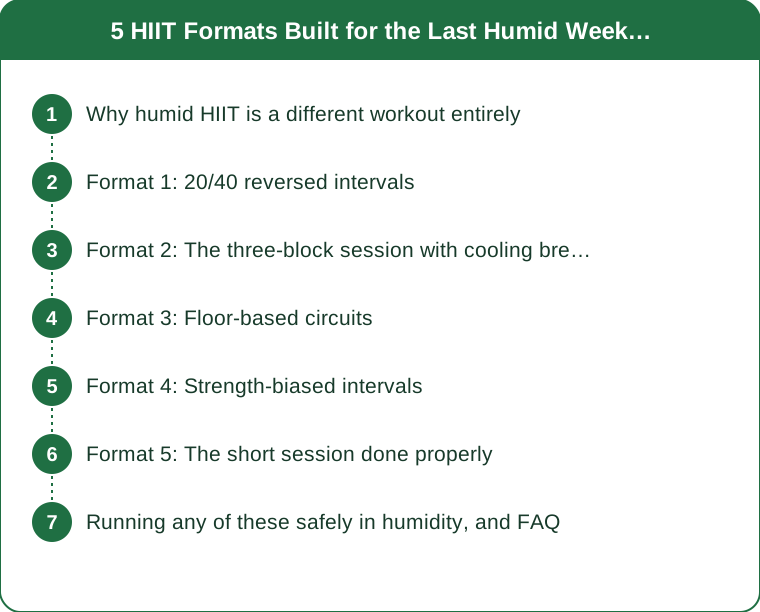
Why humid HIIT is a different workout entirely
Understanding the mechanism explains why the format changes below actually work.
Sweat only cools you when it evaporates. In humid air, sweat runs off the skin without evaporating, which means you lose fluid and get almost none of the cooling benefit. This is why 26C at 85% humidity is far harder than 32C in dry air.
Cardiac output splits between muscle and skin. As core temperature rises, more blood is sent to the skin surface for cooling, leaving less for working muscle. The heart compensates with higher rate, so the same interval produces a higher heart rate and a shorter time to fatigue.
Heat accumulates across intervals. In a standard HIIT session, each work bout adds heat and each short recovery removes only some of it. The net accumulation is what causes the collapse in later rounds that people misread as poor conditioning.
The practical consequence: in humid conditions, the limiting factor is thermal, not muscular or cardiovascular capacity. Training formats that respect that produce a better stimulus than formats that ignore it.
The design principle behind all five formats: shorter work, longer recovery, and structural breaks that let core temperature settle - keeping intensity high per bout while limiting total heat accumulated.
Format 1: 20/40 reversed intervals
The structure: 20 seconds of maximum-quality work, 40 seconds of complete rest. 10 rounds, one exercise, or alternate two.
The standard 40/20 format is one of the most popular in group fitness, and it is also one of the worst choices in humidity. Reversing the ratio keeps the intensity of each bout genuinely high while more than doubling the cooling window.
Why it works in heat: the work bout is short enough that you can go genuinely hard, and the 40-second recovery is long enough to allow heart rate to drop meaningfully and for some heat to dissipate.
How to run it: pick one movement you can perform at high quality - squat jumps, kettlebell swings, skater bounds, or a bike sprint. Perform 20 seconds at an effort you could not sustain for 40. Rest completely, standing or walking, not slumped over.
The check: if round 8 looks meaningfully worse than round 2, the work bout is too long or your effort in early rounds is too high. Quality across all rounds is the target.
Format 2: The three-block session with cooling breaks
The structure: three blocks of 5 minutes work, with 3 full minutes of active cooling between blocks.
Most HIIT sessions run continuously for 20-30 minutes with only short recoveries. In humid conditions, that guarantees heat accumulation. Building in genuine breaks changes the thermal profile of the whole session.
Why it works: three minutes is enough for heart rate to return near baseline and for a real reduction in skin and core temperature, especially with a fan or cold water on the neck and wrists.
How to run it: each 5-minute block is an EMOM or a 30/30 alternating format. Between blocks, walk, drink, and actively cool - a cold flannel on the back of the neck makes a measurable difference to perceived heat.
Total session: about 21 minutes, of which 15 is work. That is a complete HIIT session by any standard, structured so the last block is as good as the first.

Format 3: Floor-based circuits
The structure: 5 exercises performed on or near the floor, 30 seconds each, 30 seconds rest, 3 rounds.
Standing, full-body, continuous movements - burpees, high knees, jumping jacks - generate the most metabolic heat and involve the largest muscle mass. Floor-based work reduces the thermal load while still driving heart rate.
Why it works: floor level is genuinely cooler in most rooms, since warm air rises. Beyond that, exercises like mountain climbers, plank variations, glute bridges, and dead bugs produce a strong stimulus with less total heat than repeated jumping.
A sample circuit: mountain climbers, glute bridge marches, plank shoulder taps, dead bugs, and a floor-based core hold. Thirty on, thirty off, three rounds through.
The honest limitation: this format is less cardiovascularly demanding than jumping work. In humid conditions it will still elevate your heart rate substantially, because heat does the rest.
Format 4: Strength-biased intervals
The structure: 6-8 reps of a loaded movement every 90 seconds, 8-10 rounds.
When the environment limits cardiovascular work, shifting the emphasis to strength keeps training productive without fighting the heat.
Why it works: a set of 6-8 challenging reps takes 20-30 seconds and generates far less total heat than 45 seconds of continuous conditioning, while the long recovery keeps quality high.
How to run it: choose a goblet squat, dumbbell press, or Romanian deadlift at a weight where 6-8 reps is genuinely hard. Perform the set at the top of each 90-second window and rest for the remainder.
The benefit beyond heat management: late summer is a good time to build strength that supports autumn training. Formats that shift toward strength during the hottest weeks are periodisation rather than compromise.
Format 5: The short session done properly
The structure: 8 minutes total. 8 rounds of 20 seconds work, 40 seconds rest, one movement, everything you have.
The most under-used option in hot weather is simply doing less, done harder.
Why it works: total heat accumulation is a function of duration as well as intensity. An 8-minute session at genuinely high intensity produces a strong stimulus and gives your body very little time to overheat.
How to run it: the movement should be one you can execute safely when fatigued - bike or rower sprints are ideal, kettlebell swings work well, complex barbell movements do not.
Why people resist this: an 8-minute workout feels insufficient. In late August, an 8-minute session done at full intensity is a better training stimulus than a 30-minute session where the last 20 minutes are a heat-limited shuffle.
How to know it worked: you should be genuinely unable to continue at the same quality for a ninth round. If you could do fifteen, it was not an 8-minute session, it was a warm-up.
Running any of these safely in humidity, and FAQ
Hydrate before, not just during. Arriving at a humid session already down on fluid guarantees a worse session. Include sodium if you sweat heavily - fluid alone does not replace what humid-weather sweating loses.
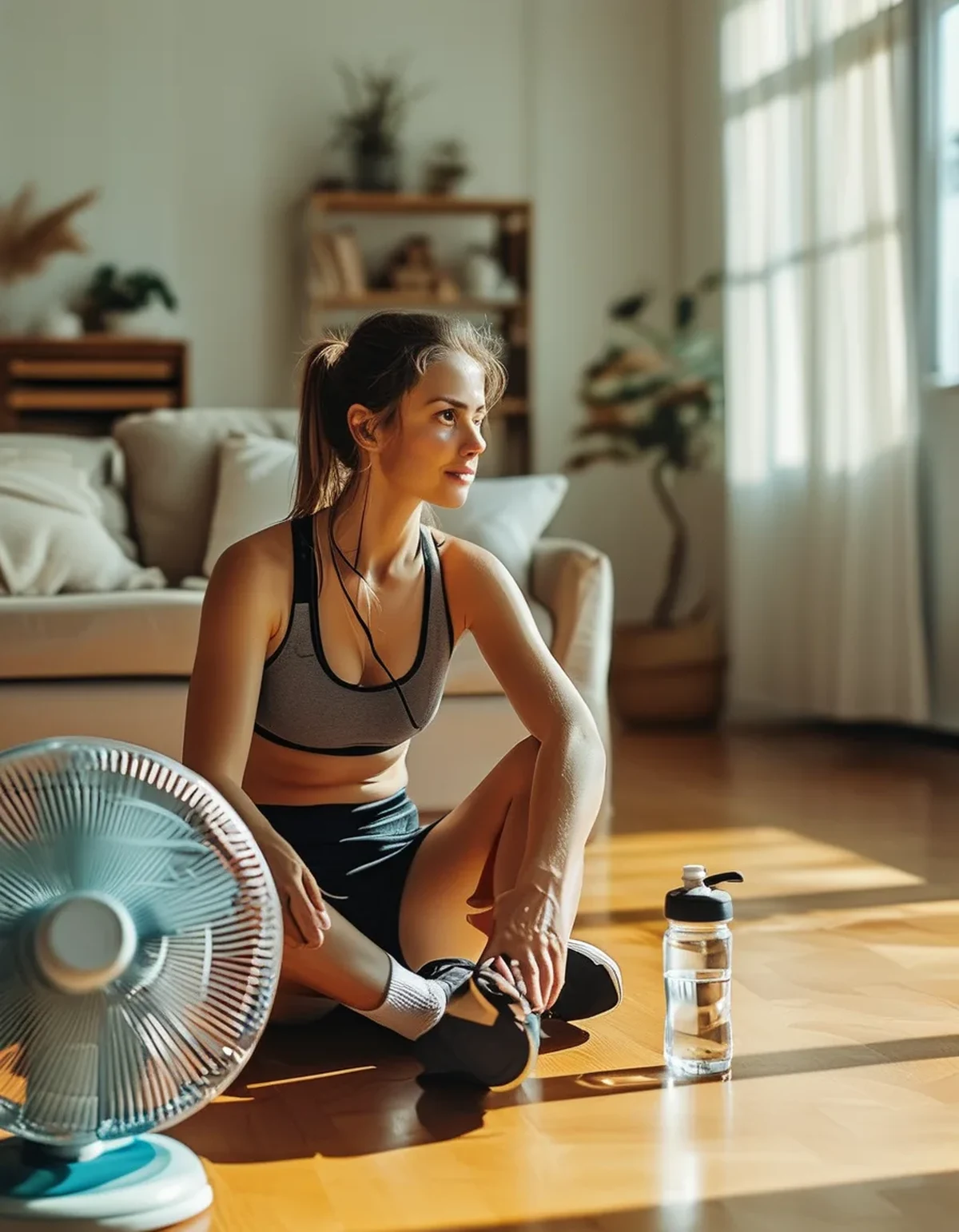
Use airflow aggressively. A fan is the single most effective intervention available indoors, because it restores some evaporative cooling that still air prevents.
Cool the neck and wrists between blocks. Cold water on areas with surface blood flow reduces perceived heat quickly, and perceived heat is a major driver of how hard a session feels.
Train earlier. Humidity typically peaks overnight and in the early morning in absolute terms, but the combination of heat and humidity is usually most manageable in early morning. Evening sessions in late summer often occur at the worst combined load of the day.
Know when to stop. Dizziness, nausea, headache, confusion, chills, or stopping sweating are signs to end the session and cool down immediately. None of these are things to push through, and heat illness escalates faster than most people expect.
This is general information, not medical advice. Seek medical attention for symptoms of heat exhaustion or heat stroke.
Is it bad to do HIIT in humid weather?
Not inherently, but the effective intensity is higher than the workout looks on paper because heat adds physiological load. Restructuring toward shorter work bouts and longer recoveries keeps the training stimulus without the accumulated heat stress.
Why does my heart rate spike so much faster in summer?
Blood is diverted to the skin for cooling, leaving less available to deliver oxygen to muscle, so the heart beats faster at the same workload. Humidity worsens this because sweat cannot evaporate and cooling fails.
Should I just train indoors with air conditioning?
It is a reasonable choice, and it removes the constraint entirely. The trade-off is that if you have races or events outdoors in the heat, some heat exposure builds genuine adaptation over ten to fourteen days.
Are shorter workouts really enough?
In hot conditions, yes. Eight to fifteen minutes of genuinely high-intensity work produces a strong stimulus, and it is measurably better than thirty minutes where the last two-thirds are limited by overheating rather than by effort.
How do I know if I am overheating rather than just working hard?
Working hard feels like effort in your legs and lungs. Overheating feels like dizziness, nausea, headache, chills, or skin that has stopped sweating. The second list means stop and cool down, not push through.
TL;DR:
- Humidity blocks evaporative cooling, so heat accumulates across intervals and heart rate climbs at the same workload.
- Reverse the work-to-rest ratio: 20 seconds on, 40 off, beats the standard 40/20 in humid air.
- Build genuine cooling breaks between blocks rather than running continuously for 30 minutes.
- Floor-based and strength-biased formats deliver a stimulus with far less thermal load.
- Eight hard minutes beats thirty limited ones - shorter sessions are a legitimate late-summer strategy.
You did not lose your conditioning in August. You have been trying to run a June workout in air that will not let your sweat evaporate.
Keep Reading
This article is for general informational and styling purposes only. Fit, sizing, and product availability may vary.