5 HIIT Formats That Fit Around a Heavy Lifting Week
Quick Answer: The interference effect is real but smaller than gym folklore suggests. What matters is modality, proximity, and total volume. Cycling and rowing interfere with leg strength far less than running does; 6 or more hours between sessions blunts most of the conflict; and keeping HIIT to two sessions of 10 to 20 minutes a week costs a strength-focused lifter almost nothing. The five formats below are ordered by how much recovery they cost, from least to most.
The usual mistake is not doing HIIT at all - it is doing the same 25-minute all-out session on a day when your legs needed to be fresh.

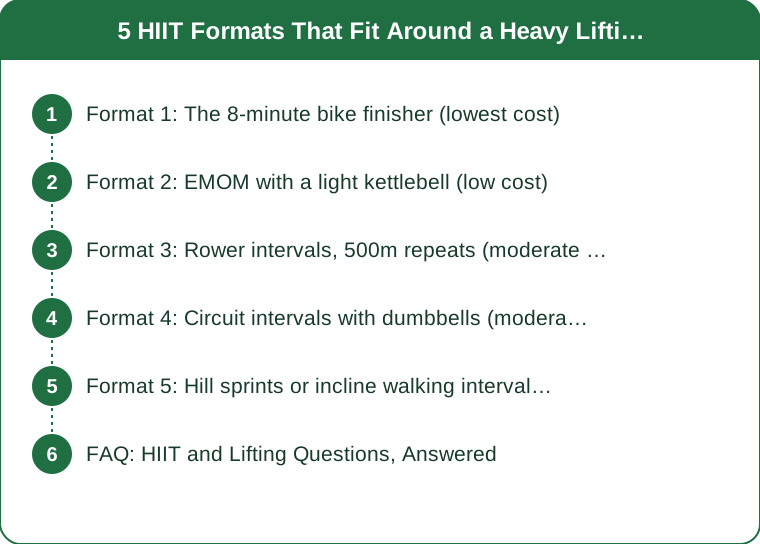
Format 1: The 8-minute bike finisher (lowest cost)
What it is: 8 rounds of 20 seconds hard, 40 seconds easy, on an air bike or a stationary bike. Total time including warm-up: about 15 minutes.
Where it goes: immediately after an upper body session, or on a rest day. Never before legs and never on the same day as heavy squats or deadlifts.
Why it costs the least. Cycling is non-impact and involves a limited movement pattern, so it creates far less muscle damage than running or jumping. The interference effect is consistently smallest for cycling in studies comparing modalities, which is why it remains the default conditioning tool for strength athletes.
How hard is hard: the 20 seconds should be genuinely uncomfortable by round 4 - a 8 out of 10 - but you should be able to complete all 8 rounds without form falling apart. If round 8 is a struggle to finish, you went too hard in round 1.
The seasonal note: as outdoor running gets less appealing in autumn rain, the bike finisher becomes the easiest conditioning to keep consistent. Consistency beats intensity here by a wide margin.
Progression: add rounds up to 12 before making the work intervals longer. More rounds at the same intensity is a gentler progression than longer intervals, and it keeps recovery cost predictable.
Format 2: EMOM with a light kettlebell (low cost)
What it is: every minute on the minute, 12 to 15 kettlebell swings, for 10 minutes. Rest is whatever remains in each minute - typically 25 to 35 seconds.
Where it goes: after upper body, on a rest day, or as a standalone session on a light day. Avoid the day before heavy deadlifts, since swings load the posterior chain.
Why it works for lifters. The self-limiting structure means you cannot accidentally destroy yourself - the clock caps the volume. The hinge pattern reinforces technique you already train, and the load is light enough that it functions as conditioning rather than strength work.
Load selection: light enough that the last round looks like the first. For most people that is 12 to 16kg, considerably lighter than their working swing weight. If form degrades by minute 7, the bell is too heavy.
Why the rest matters: the incomplete recovery between rounds is what makes this conditioning. Finishing your reps in 20 seconds and resting 40 is exactly the intended shape.
Progression: add reps per minute (12 to 15) or add minutes (10 to 12), not both at once. Fifteen minutes is a sensible ceiling for something that is meant to sit alongside lifting rather than replace it.
Format 3: Rower intervals, 500m repeats (moderate cost)
What it is: 4 to 6 rounds of 500m on the rower with 90 seconds rest. Total time: 20 to 25 minutes with warm-up.
Where it goes: on a dedicated conditioning day, or after an upper body session if you are not deadlifting the following day. This one has a real recovery cost - it loads the posterior chain and the grip meaningfully.
Why it earns its place anyway. Rowing is non-impact and full-body, and the fixed distance makes progress measurable in a way that time-based intervals do not. Watching your 500m splits improve over eight weeks is unusually motivating, and measurable progress is what keeps conditioning in the program.
Pacing: aim for splits you can hold for all rounds within about 3 seconds. Going out hard on round 1 and fading to round 6 trains pacing failure rather than conditioning.
The grip and back caveat: rowing fatigues grip and erectors, which are the same tissues heavy pulling relies on. Leave at least 24 hours before deadlifts, and skip this format entirely in a week where you are testing pulling strength.
Progression: hold the same splits and add a round, or hold the rounds and drop the splits by 2 seconds. Alternate between the two rather than pushing both.

Format 4: Circuit intervals with dumbbells (moderate to high cost)
What it is: 4 exercises, 40 seconds work and 20 seconds rest each, 3 to 4 rounds. A typical set is goblet squat, push-up, dumbbell row, and reverse lunge.
Where it goes: on a standalone conditioning day, ideally 48 hours from your heaviest lower body session. This is the format most likely to interfere with lifting, because it is essentially light resistance training under fatigue.
Why it is worth including anyway: it builds work capacity in movement patterns you already use, it needs almost no equipment, and it travels well. For anyone who trains at home or away from a gym regularly, this is the most practical format on the list.
The critical rule: keep the loads genuinely light. 40% of what you would use for a working set is about right. The goal is elevated heart rate, not accumulated muscle damage - heavy circuits are the classic way lifters wreck a training week without realizing why.
Watch the lunges specifically. Unilateral leg work under fatigue produces the most soreness of anything here, and that soreness lands squarely on your next squat day. Substitute step-ups or drop them in weeks with heavy legs.
Progression: add a round before adding load. Once you are at 4 rounds, change the exercises rather than getting heavier - the format is a conditioning tool, and turning it into a strength session defeats the purpose.
Format 5: Hill sprints or incline walking intervals (highest cost, highest specificity)
What it is: 6 to 8 rounds of 20 to 30 seconds uphill hard, walking back down as recovery. The low-impact variant is 8 rounds of 60 seconds at a steep treadmill incline with 60 seconds easy.
Where it goes: on a day well separated from lower body lifting - ideally 48 hours either side. This is the highest-interference format on the list and it needs to be treated accordingly.
Why it is here at all: it is the most potent conditioning stimulus per minute, and hills reduce impact stress compared to flat sprinting while raising the metabolic cost. For anyone who wants genuine cardiovascular improvement rather than just a sweat, this is the format that delivers.
The honest cost: sprinting creates real muscle damage in the hamstrings and calves, and soreness peaks 24 to 48 hours later. If your squat feels heavy three days running, this is usually why. Cap it at once a week during a strength-focused block.
Warm up properly - this one is not optional. Ten minutes of easy work plus progressive build-ups before the first hard rep. Cold hamstrings and maximal sprinting is the most reliable way to strain something, and the risk climbs as the weather cools.
Seasonal note: early autumn is the best sprinting weather of the year - cool enough to work hard, warm enough not to need a 20-minute warm-up. It is the right time to use this format, and the right time to swap it for the incline treadmill version once mornings drop below about 8°C.
Progression: add rounds up to 10, then extend to 40 seconds. Never both.
FAQ: HIIT and Lifting Questions, Answered
How much HIIT can I do without losing strength?
Two sessions of 10 to 20 minutes per week is well tolerated by most lifters. Interference becomes noticeable when conditioning exceeds roughly three sessions weekly or when sessions run long and land close to heavy lower body work.
Should HIIT come before or after lifting?
After, if on the same day - lifting first preserves the quality of the work that matters most for strength. Better still, separate them by 6 or more hours, which substantially reduces the interference.
Does cardio really kill gains?
Not at realistic volumes. The interference effect is well documented but modest, is largest for high-volume running combined with leg training, and is minimal for short cycling or rowing intervals done on separate days.
What about HIIT on rest days?
A short low-cost format like the bike finisher works fine on a rest day. A high-cost format like hill sprints on a rest day is not a rest day - it is a training day, and it should be planned as one.
This is general information, not medical advice. Get clearance from a healthcare professional before starting high-intensity training if you have any cardiovascular concerns.
TL;DR:
- Interference is real but modest - it depends on modality, proximity, and volume, not on cardio being inherently bad.
- Bike finishers and light kettlebell EMOMs cost the least; circuits and hill sprints cost the most.
- Keep it to two sessions of 10 to 20 minutes weekly, separated from heavy lower body work by 24 to 48 hours.
- Same-day conditioning goes after lifting, ideally 6+ hours later.
Pick one low-cost format as your default and one higher-cost format for weeks when your lifting is lighter. Early autumn is the best window of the year for the outdoor version - and once the mornings get properly cold, the bike finisher is what keeps the habit alive through winter.
Keep Reading
This article is for general informational and styling purposes only. Fit, sizing, and product availability may vary.