5 HIIT Formats You Can Do With a Single Chair
Quick Answer: A dining chair gives you elevation, a hand support, and a stable anchor — which covers step-ups, incline and decline push-ups, split squats, dips, and elevated core work. Five formats below, each 12-20 minutes, all low-noise enough for an upstairs apartment. Use a chair with four solid legs against a wall; skip anything with wheels or a swivel.
Every apartment workout list eventually asks you to buy something. This one doesn’t.
The chair you’re probably sitting on right now replaces a plyo box, a bench, and a set of parallettes — and it turns out most of what a HIIT session needs is a stable surface at knee height.

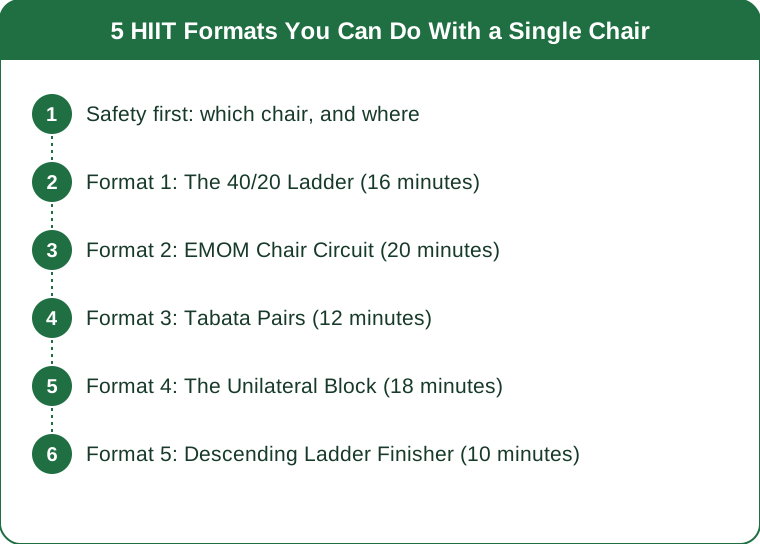
Safety first: which chair, and where
Two minutes here saves you an ankle later.
Use: a dining chair with four legs, a solid seat, and no wheels. Wooden or metal frame. Push the back against a wall so it can’t slide backward when you push off it.
Don’t use: office chairs (they swivel and roll), folding chairs (they fold), plastic patio chairs (they flex under load), or anything with a padded seat soft enough that your foot sinks in.
Test it: stand on the seat, shift your weight side to side, and step down. If it creaks, wobbles, or slides on the floor, find another chair or put a rug under it.
For downstairs neighbors, every format below is designed with no jumping. Step-ups and split squats are quiet by nature — the noise in most apartment workouts comes from landing, and there’s no landing here.
Format 1: The 40/20 Ladder (16 minutes)
The most straightforward entry point, and the one to start with if you haven’t trained in a while.
Structure: 40 seconds of work, 20 seconds of rest, 4 exercises, 4 rounds.
- Chair step-ups, alternating legs — drive through the whole foot, stand tall at the top
- Incline push-ups, hands on the seat — easier angle means you get more quality reps
- Bulgarian split squats, rear foot on the seat — 40 seconds per leg, so this round is 80 seconds
- Elevated mountain climbers, hands on the seat — the incline reduces wrist strain considerably
Why it works: the 2:1 work-to-rest ratio keeps heart rate elevated between exercises rather than letting it fully recover, so you get a genuine conditioning stimulus without any high-impact movement. The alternating upper-lower order lets each area partially recover while the other works, which is what allows you to hold intensity for the full 16 minutes.
Format 2: EMOM Chair Circuit (20 minutes)
Every Minute On the Minute — you do the prescribed reps at the top of each minute and rest for whatever’s left. Faster work earns more rest, which is a surprisingly effective self-regulating mechanism.
Structure: 20 minutes, rotating through 4 movements, 5 times each.
- Minute 1: 12 chair step-ups (6 per leg)
- Minute 2: 10 incline push-ups
- Minute 3: 10 split squats (5 per leg)
- Minute 4: 20 elevated mountain climbers
Repeat that block 5 times.
Why it works: EMOM removes the pacing decision entirely, which is where most home workouts fall apart. The clock is in charge. Scale by adjusting reps, not minutes — if you’re finishing with only 10 seconds to spare, drop 2 reps from that movement rather than pushing through with degraded form.
Best for: days when your motivation is low but you’ll show up if the structure is decided for you.

Format 3: Tabata Pairs (12 minutes)
Two exercises, alternating, at true Tabata timing: 20 seconds hard, 10 seconds rest, 8 rounds.
Structure: 3 blocks of 4 minutes, 1 minute rest between blocks.
- Block A: Alternate chair step-ups and incline push-ups
- Block B: Alternate split squats (switch legs each round) and elevated plank shoulder taps
- Block C: Alternate chair-supported reverse lunges and elevated mountain climbers
Why it works: the 10-second rest is short enough that this genuinely qualifies as high intensity — you don’t recover, you just stop briefly. Twelve minutes is all you need, and honestly all most people can hold at real intensity.
One caution: Tabata timing only works if the 20 seconds are actually hard. If you’re pacing yourself through them, use Format 1 instead — the shorter rest without the higher effort is just a rushed workout.
Format 4: The Unilateral Block (18 minutes)
Everything on one leg or one arm at a time. Harder than it looks, and the most useful format on this list if you run or hike.
Structure: 6 rounds of 3 minutes — 45 seconds work, 15 rest, three times through.
- Single-leg chair step-ups, same leg the entire 45 seconds
- Single-leg Romanian deadlift, fingertips on the chair back for balance
- Split squats, rear foot elevated
Rounds 1-3 lead with the left leg; rounds 4-6 lead with the right.
Why it works: unilateral work exposes side-to-side differences that bilateral movements hide, and it demands stabilization from the hips and core that a two-legged squat never asks for. Most people discover a noticeable gap between sides in the first session — that gap is the point. Nearly every real-world movement, including every step you take running, is single-leg.
Format 5: Descending Ladder Finisher (10 minutes)
Short, brutal, and perfect for tacking onto the end of a strength session or a run.
Structure: work down a rep ladder with no prescribed rest — you rest when you need it, and the goal is to need less over time.
Perform 10 reps of each, then 9 of each, then 8, all the way down to 1:
- Chair step-ups (count per leg)
- Incline push-ups
- Chair-supported reverse lunges (per leg)
Why it works: the descending structure is psychologically clever — every round is shorter than the last one, so the workout gets easier to face exactly as your legs get heavier. Time it, write the number down, and try to beat it in three weeks. That’s a clean, honest progression metric that needs no equipment at all.
Scale it: start the ladder at 8 rather than 10 if you’re new to this. The full 10-to-1 is roughly 165 reps of each movement.
TL;DR:
- One sturdy four-legged chair against a wall covers step-ups, incline push-ups, split squats, and elevated core work.
- Five formats, 10-20 minutes each, all no-jump and apartment-friendly.
- Start with the 40/20 Ladder; use EMOM on low-motivation days; save Tabata Pairs for when you can genuinely go hard.
- The Unilateral Block is the highest-value one if you run or hike.
Pick one, run it twice a week for a month, and track the descending ladder time as your progress marker. The equipment budget for the entire program is a chair you already own.
Keep Reading
This article is for general informational and styling purposes only. Fit, sizing, and product availability may vary.