5 HIIT Workouts That Look Deceptively Easy in a Photo but Wreck You in Practice
Quick Answer: The hardest HIIT sessions often use simple bodyweight movements at short work-to-rest ratios rather than complex, equipment-heavy exercises — a photo of someone doing bodyweight squats doesn’t convey the difficulty of 20 seconds on, 10 seconds off for eight rounds, which is exactly why these sessions surprise people who judge difficulty by how the movement looks.
Equipment and visibly complex movement patterns often signal difficulty in fitness photos, but the actual physiological demand comes from work-to-rest ratio and total volume, not visual complexity.

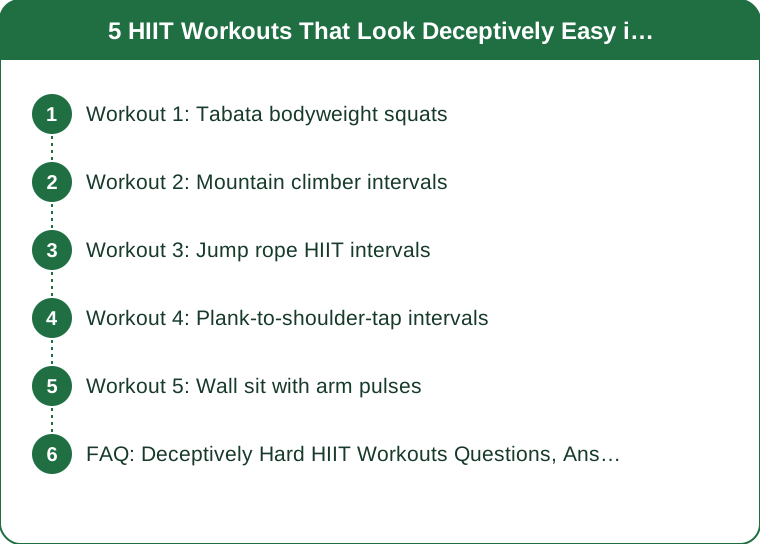
Workout 1: Tabata bodyweight squats
Twenty seconds of squats, ten seconds rest, repeated for eight rounds — just four minutes total. In a photo, it’s just someone squatting. In practice, the extremely short rest period doesn’t allow full recovery between rounds, causing a rapid, cumulative burn that catches people expecting an “easy because it’s just squats” session off guard.
Workout 2: Mountain climber intervals
A stationary, low-equipment movement that photographs as mild floor work, but sustained mountain climbers at a fast pace elevate heart rate into a genuinely high zone quickly due to the combined core, shoulder, and leg engagement working simultaneously at speed.
Workout 3: Jump rope HIIT intervals
A jump rope looks like a simple, almost playful prop in photos, but sustained fast-paced jumping intervals are among the highest calorie-burn-per-minute activities in typical HIIT programming, and the repetitive impact adds cumulative fatigue that isn’t visible in a still image.

Workout 4: Plank-to-shoulder-tap intervals
A held plank position looks static and unremarkable in a photo, but adding continuous shoulder taps at a fast pace for short, intense intervals creates significant core and shoulder fatigue that builds much faster than the static appearance suggests.
Workout 5: Wall sit with arm pulses
Perhaps the most deceptive of all — a wall sit looks completely motionless in a photo, giving no visual indication of the isometric leg burn that builds intensely over even 30-45 seconds, especially with the added arm pulse component increasing time under tension.
FAQ: Deceptively Hard HIIT Workouts Questions, Answered
Why does short rest matter more than the exercise choice itself?
Short rest periods prevent full recovery of phosphocreatine energy stores between efforts, forcing the body to rely more on less efficient energy pathways sooner — this mechanism drives difficulty regardless of how simple the movement looks.
Are bodyweight HIIT workouts actually as effective as equipment-based ones?
Yes, for cardiovascular and metabolic conditioning specifically — equipment can add resistance for strength benefits, but the interval structure itself (work-to-rest ratio, total volume) drives most of the cardio and calorie-burn effect.
How can I judge a HIIT workout’s real difficulty before trying it, since photos are unreliable?
Look at the actual work-to-rest ratio and total round count rather than the exercises pictured — a 20-second-on, 10-second-off structure for 8+ rounds is a more reliable difficulty signal than which specific movement is shown.
TL;DR:
- Difficulty in HIIT comes from work-to-rest ratio and volume, not how complex or equipment-heavy the movement looks
- Simple bodyweight movements like squats, mountain climbers, and wall sits can be deceptively brutal at short rest intervals
- A still photo can’t convey isometric burn or cumulative fatigue building across rounds
- Judge a workout’s real difficulty by its interval structure, not by how intense the pictured exercise appears
Keep Reading
This article is for general informational and styling purposes only. Fit, sizing, and product availability may vary.