How Much HIIT Is Too Much: The Frequency Question Answered
HIIT’s marketing suggests daily; HIIT’s physiology suggests otherwise — the intensity that makes it efficient makes it expensive, and the everyday-HIIT pattern is the plateau-and-burnout recipe the research keeps documenting. The frequency answer: the math, the dose and the week that works.

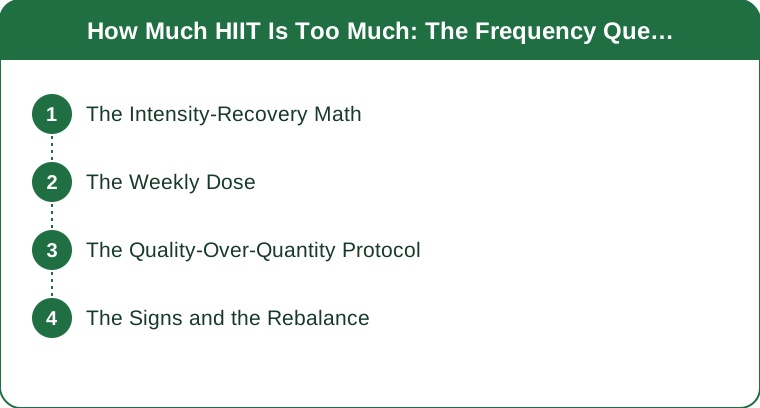
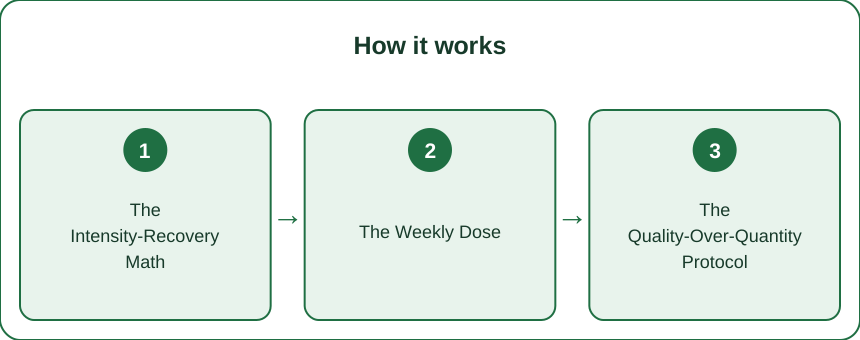
The Intensity-Recovery Math
Why HIIT bills differently: the stress accounting (true high-intensity work taxes the nervous system, not just muscles — the recovery cost per minute runs multiples of steady cardio’s; the 20-minute HIIT session and the 60-minute walk aren’t comparable stressors), the diminishing-returns curve (HIIT’s adaptations plateau quickly with added frequency — the third weekly session adds little the second didn’t; the fifth adds fatigue), the everyday-HIIT pattern autopsy (the daily-burpee crowd’s arc — weeks of gains, then the plateau, the dragging sessions, the overtraining-signs cluster; the intensity that was the feature becomes the bug), and the honest definition note (much ‘HIIT’ is actually moderate intervals — the true-HIIT effort that justifies the recovery math is near-maximal; the gentler circuit classes can run more often because they’re not really billing HIIT prices).
The Weekly Dose
The evidence-aligned guidelines: the 1-3 sessions range (two true-HIIT sessions weekly is most people’s sweet spot — the dose capturing the adaptations; the third for the well-recovered and well-trained; the one for the beginner and the loaded-life week), the 48-hour spacing (the between-HIIT recovery window — the Monday-Thursday pattern over the Monday-Tuesday), the surrounding-week design (the HIIT sessions embedded in easy-movement days — the zone-2 base and walking floor that HIIT garnishes; the 80/20 shape from the heart chapter with HIIT as the 20), and the life-stress integration (the cortisol-and-exercise chapter’s bucket — the brutal work week downgrades the HIIT day to a walk; intensity fits in calm weeks, not around them).

The Quality-Over-Quantity Protocol
Making fewer sessions count: the true-effort standard (the work intervals genuinely hard — the can’t-speak-comfortably tier; the halfhearted daily HIIT delivers neither HIIT’s adaptations nor easy cardio’s recovery; pick a lane per session), the format rotation (the bike sprints, the stair repeats from the stair-snack chapter, the low-impact library for the joint-aware — the modality varied, the intensity principle constant), the session length honesty (15-25 minutes of real work-and-recovery intervals is complete — the 45-minute ‘HIIT’ class is intervals-plus-conditioning, fine but differently billed), and the warm-up non-negotiable (near-maximal efforts on cold tissue is the injury lane — the 5-10 minute ramp that makes intensity safe).
The Signs and the Rebalance
Reading your dose: the too-much signals (the overtraining cluster — performance dropping, sleep degrading, sessions dreaded; the HIIT-specific tell of intervals getting slower week over week), the rebalance protocol (the HIIT week halved, the walking-and-strength floors maintained, the sleep-and-food audit — the deload that restores the intervals’ pop within weeks), the enough honesty (two quality sessions plus the daily-movement floor plus twice-weekly strength is a COMPLETE program — the more-HIIT itch usually wants more results, which more recovery delivers better), and the reframe (HIIT is espresso — brilliant dosed, jittery abused; the week built on walking with HIIT shots beats the week built on HIIT with collapse scheduled). Two shots weekly, spaced and real: the dose, answered.
True HIIT bills nervous-system prices, two sessions weekly is the sweet spot, 48 hours between, effort honest or don’t. HIIT is espresso — dose it right and the week works.
Keep Reading
This article is for general informational and styling purposes only. Fit, sizing, and product availability may vary.