How Many HIIT Sessions Per Week Actually Work? The Honest Math
Quick Answer: For most people, two to three genuine HIIT sessions per week is the productive ceiling, with at least 48 hours between them. True high-intensity work taxes the nervous system and recovery capacity in a way that compounds - daily HIIT converts a powerful stimulus into accumulating fatigue, stalled progress, and disturbed sleep. If you love training six days a week, the fix is not less training; it is reclassifying most days as strength, easy cardio, or genuinely easy movement, and defending the hard days by making the easy days easy.
The app schedules HIIT for Monday, Tuesday, Wednesday, Thursday, and Friday, and calls Saturday a bonus burn. Somewhere around week three you are sleeping worse, dreading warm-ups, and wondering why the workouts that used to leave you buzzing now just leave you flattened. The workouts did not change. The dose did.

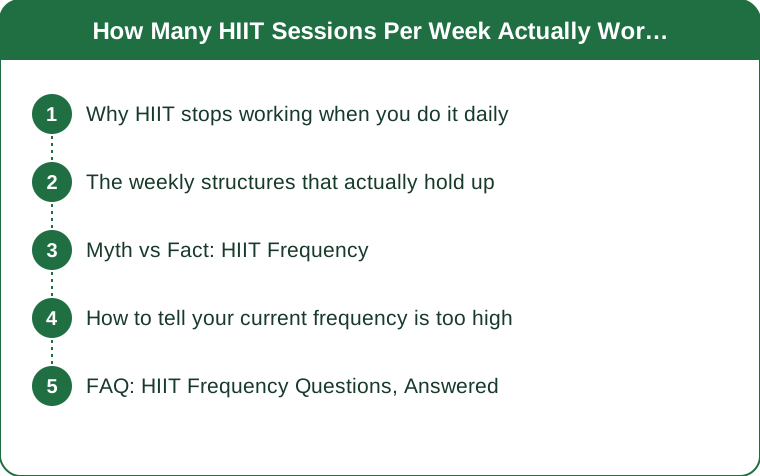
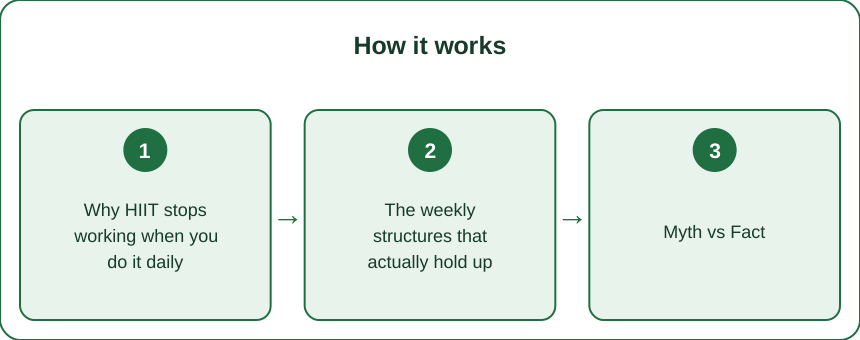
Why HIIT stops working when you do it daily
The value of high-intensity work comes from a disruption-recovery cycle, and doubling the disruption halves the recovery.
HIIT is a stress signal, not a magic format. The adaptations people chase - improved VO2 max, better repeat-sprint ability, favorable body-composition effects - are built in the recovery window after the session, when the body responds to the disruption. Interrupt that window with another maximal session and you file a new stress claim before processing the last one.
The nervous system is the quiet bottleneck. Muscles feel recovered within a day or two, but the neural and hormonal systems that let you actually hit high intensity recover more slowly. This is why daily HIIT produces a signature pattern: you show up, the timer runs, and your supposed sprint is maybe 80 percent of true intensity. You are doing hard-feeling moderate workouts - all of the fatigue, a fraction of the stimulus.
Intensity is definitional, and it decays invisibly. If everything is high intensity, nothing is. A true work interval is one you could not extend much past the beep. When frequency climbs, interval quality drops before anyone notices, because effort still feels hard - it is just hard-because-tired rather than hard-because-fast.
Sleep is the tell. One of the most consistent overreach signals is HIIT-heavy weeks producing restless, unrefreshing sleep and a resting heart rate creeping up several beats for days. When the workout designed to improve your health is degrading the biology that delivers health, the dose is wrong.
None of this indicts HIIT. Two or three quality sessions weekly is one of the best time-per-benefit deals in fitness. The indictment is of the calendar that schedules five.
The weekly structures that actually hold up
Build the week around hard-easy alternation and everything else falls into place.
The 2-session base (most people, most seasons). Two HIIT days - say Tuesday and Friday - separated by 72 hours. Fill other days with strength work, brisk walking, easy cycling, yoga, or rest. This dose captures the large majority of HIIT’s measurable benefits with almost none of its overuse risk, and it survives busy weeks intact.
The 3-session ceiling (established, sleeping well, eating enough). Monday, Wednesday, Saturday - never back-to-back. The third session should be the first thing dropped in any week where sleep shortens, life stress spikes, or a cold is circulating through the house.
Pair HIIT with strength, do not replace it. Strength training on the non-HIIT days is the combination with the best long-term returns for women - muscle and bone respond to loading in ways intervals cannot replicate. If time forces a choice, alternating weeks of emphasis beats abandoning either.
Make easy days visibly easy. The classic failure is decorating rest days with medium-hard classes until every day is moderately hard and no day is truly hard or truly easy. A useful test: on an easy day you can hold a conversation throughout and finish feeling better than you started. Dress code honesty helps more than it should - the days you are in your softest leggings and not your competition-ready kit are a signal to your own brain about what today is for.
Anchor the week, not the day. Two quality sessions in a week you actually completed beats five scheduled sessions abandoned by Thursday. Consistency across months is the entire mechanism.

Myth vs Fact: HIIT Frequency
Myth: Daily HIIT means faster results. Fact: Past two to three weekly sessions, added HIIT delivers shrinking benefit and growing fatigue. Progress trackers show the pattern clearly: performance climbs on lower frequency with real recovery and flatlines on daily schedules.
Myth: If I am not sore, I am recovered. Fact: Soreness tracks muscle damage, not nervous-system readiness. You can be pain-free and still unable to produce true intensity - which is precisely the state daily HIIT manufactures.
Myth: A 20-minute workout cannot be overtraining. Fact: Duration is not dose. Twenty genuinely maximal minutes is a larger systemic stress than an hour of easy movement, and five such sessions weekly out-stresses many marathon training plans - without the aerobic base to absorb it.
Myth: Women need daily HIIT to change body composition. Fact: Body composition responds to the combination of strength training, adequate protein, overall activity, and sleep - with HIIT as a useful accelerant, not the engine. The daily-burn model actively undermines two of those four (sleep and strength quality).
Myth: Skipping a scheduled HIIT day is lost progress. Fact: A skipped session when you are under-recovered is the progress. The adaptation you were waiting for happens on exactly the kind of day you were about to interrupt.
Myth: If the class is called HIIT, it counts as HIIT. Fact: Many branded classes are interval-flavored moderate cardio - fun, useful, but not maximal. Ironically that makes them fine to do more often. Count only the sessions with true near-max efforts against your two-to-three budget.
How to tell your current frequency is too high
Your body files reports; here is how to read them.
Performance drift. Same intervals, worse output for two consecutive weeks - slower sprints, lower watts, fewer rounds - despite full effort. This is the most objective signal and the least ambiguous.
Resting heart rate creep. A morning resting rate elevated 5-10 beats above your normal for three or more days, absent illness, is accumulated fatigue speaking plainly.
The dread signal. Healthy training produces some pre-workout reluctance; overreach produces a distinctive flat dread where even warm-ups feel like negotiations. Motivation is physiology wearing a costume.
Sleep fragmenting while tired. Exhausted at 10pm, wide awake at 2am - the wired-and-tired pattern is classic sympathetic overload from too much intensity, too often.
Niggles multiplying. Tendons and joints flagging in rotation - a knee this week, a shoulder next - reflects tissues repeatedly loaded at high force without full repair cycles.
Appetite and mood flattening. Under-recovery commonly suppresses appetite while elevating irritability, a combination that quietly worsens the underlying problem through under-fueling.
The fix is a deload, not a breakup. Cut HIIT to one short session for a week, keep easy movement, protect sleep, eat properly - most people feel startlingly better within five to seven days, which itself confirms the diagnosis. Then rebuild at two to three sessions and hold the line the calendar app would not.
This is general information, not medical advice. Chest pain, fainting, or symptoms that do not resolve with rest deserve a healthcare professional, not a training tweak.
FAQ: HIIT Frequency Questions, Answered
Is HIIT every day ever okay?
As a short novelty challenge with genuinely modified intensity, it will not ruin a healthy adult - but as a standing schedule it reliably produces stalled progress, worse sleep, and eroded interval quality. There is no goal daily HIIT serves that two to three quality sessions plus easy movement does not serve better.
How many rest hours do I need between HIIT sessions?
At least 48 hours between true high-intensity sessions is the standard guardrail. Everything easy - walking, mobility, light cycling, casual swimming - is welcome inside that window and generally speeds recovery rather than costing it.
Can I do HIIT and strength training in the same week?
Yes, and you should - they are complementary. Put them on separate days where possible, or strength first and short intervals after if you must combine. The pairing to avoid is heavy leg strength and maximal leg intervals on consecutive days, week after week.
I only have 25 minutes a day. Should every day be HIIT to maximize it?
No - alternate. Two or three days of true intervals, the rest split between strength and brisk easy work. Twenty-five daily minutes structured this way outperforms twenty-five daily minutes of eroding all-out efforts by a wide margin.
How do I know my intervals are actually high intensity?
An honest work interval leaves you unable to speak more than a word or two and unwilling to extend it much past the timer. If you could have doubled the interval, it was moderate cardio - valuable, but budget it differently.
TL;DR:
- Two to three true HIIT sessions weekly with 48-plus hours between them is where benefit peaks; beyond that, fatigue compounds and interval quality quietly decays.
- The nervous system recovers slower than muscles - not sore does not mean ready.
- Fill remaining days with strength and genuinely easy movement, and make easy days visibly easy.
- Rising resting heart rate, wired-and-tired sleep, dread, and two flat weeks of output are the overshoot signals; a one-week deload is the fix.
- Count only real near-max sessions against the budget - interval-flavored moderate classes are a different (and more repeatable) category.
HIIT works precisely because it is a strong signal against a quiet background. Schedule it daily and you delete the background - and with it, the signal.
Keep Reading
This article is for general informational and styling purposes only. Fit, sizing, and product availability may vary.