The Rest Between Intervals (The Half of HIIT Everyone Rushes)
Quick Answer: Rest long enough that you can repeat your previous interval at the same output — usually a 1:2 or 1:3 work-to-rest ratio for hard efforts (20 seconds on, 40–60 seconds off). If your output drops sharply, your rest is too short, and you’ve quietly converted HIIT into a moderate cardio session. Stop the workout when performance degrades rather than pushing through.
Twenty seconds of work. Ten seconds of rest. Repeat until you’d like to lie down.
That’s how most people picture HIIT, and it’s why most people aren’t actually doing HIIT. They’re doing continuous moderate work with brief pauses in it — which is a fine workout, just not the one they think they’re getting.

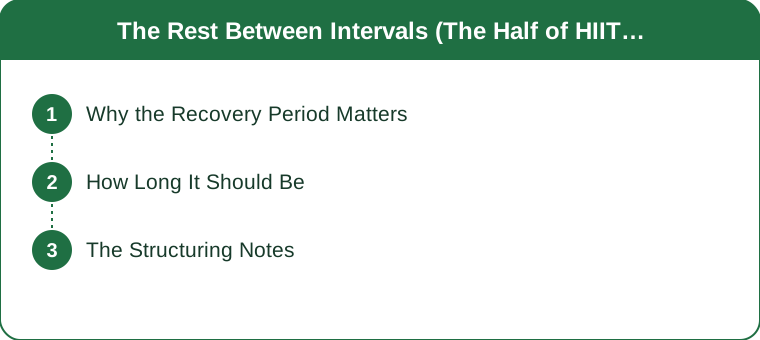
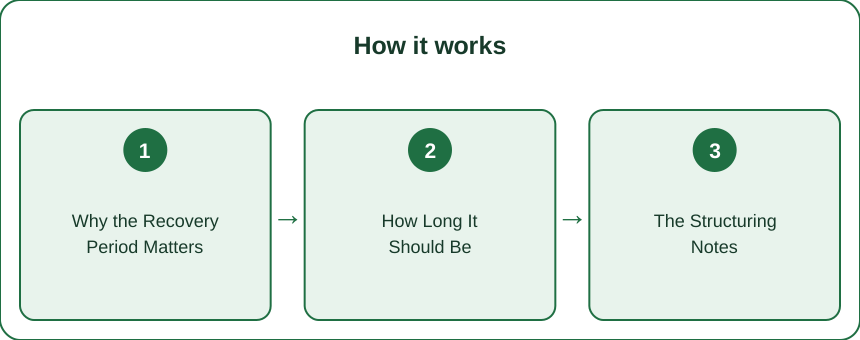
Why Does the Rest Period Actually Matter?
Because the intensity is the entire mechanism. That’s not a slogan — it’s the definition. High-intensity interval training works by getting you into a genuinely high-effort zone repeatedly, and everything else in the protocol exists to make that possible.
Here’s the problem: you cannot be intense when you’re fatigued. If you start interval four still carrying fatigue from interval three, you physically can’t produce the same power. Your heart rate might stay high, but your output falls.
Cut the rest and something specific happens — the session flattens out. Each interval gets a little weaker, the peaks disappear, and by the halfway point you’re doing sustained moderate work while feeling like you’re doing something much harder. That’s a different workout entirely. Not a worse one, necessarily. Just not the one you programmed.
Most people cut rest because resting feels lazy. Standing around at 40 seconds into a 60-second recovery, breathing hard, watching a clock, it’s genuinely hard not to start early. That instinct is the single most common reason HIIT sessions underdeliver.

How Long Should the Rest Between Intervals Be?
The honest answer is “long enough to repeat your output,” but here are working numbers.
Work-to-rest ratios by goal:
- Maximal short efforts (10–20 seconds all-out): 1:3 to 1:6 — so 20 seconds on, 60–120 seconds off
- Hard efforts (20–40 seconds): 1:2 to 1:3 — 30 seconds on, 60–90 seconds off
- Longer intervals (60–90 seconds at hard-but-sustainable): 1:1 to 1:2
- Conditioning circuits: 1:1 is common, though this sits closer to moderate work than true HIIT
The pattern: shorter and harder means proportionally longer rest. A genuine all-out 15-second sprint needs far more recovery than a 90-second threshold effort, even though the work period is much shorter.
Beginners need more rest, not less. This gets it backwards constantly. Less-trained athletes clear fatigue more slowly and need longer recovery to hit repeatable quality efforts. If you’re new to intervals, take double what the app tells you.
The test that beats every ratio: can you hit roughly the same output on this interval as the last one? Same distance, same reps, same pace? If yes, your rest is adequate. If output drops off sharply — more than about 10% — rest longer next time.
Fixed formats like EMOM (every minute on the minute) set the rest for you automatically: finish the work faster, get more recovery. That self-regulating quality is why they’re good for beginners.
Active or passive both work. Walking, easy pedaling, or simply standing all produce similar results in the research. Do whichever keeps you from cooling down completely or from sitting down and losing the plot.
5 Mistakes Everyone Makes With Interval Rest
1. Copying the 20/10 Tabata ratio for everything. Tabata’s original protocol used a specific bike test at a specific intensity for exactly 4 minutes. Applying 20/10 to burpees for 25 minutes is not Tabata; it’s just a hard time.
2. Starting the next interval early because you feel “ready.” You feel ready at about 60% recovery. That feeling is not a good instrument.
3. Adding intervals when the session feels easy. If it feels easy, the intervals weren’t hard enough. Add intensity, not volume.
4. Doing HIIT four or five times a week. True high-intensity work is systemically demanding. Two to three sessions weekly is the ceiling for most people, and the third one only if the rest of your training is light.
5. Pushing through the degradation. The moment your output falls off a cliff, the productive part of the session is over. Everything after that point is fatigue accumulation with no upside — and it’s where the injury risk lives.
How Should You Structure the Whole Session?
Fewer quality intervals beat many poor ones. Six genuinely hard efforts with full recovery produce more adaptation than fifteen degraded ones. This is the single most useful reframe in interval training.
Stop when output degrades. Set a rule in advance — when your interval falls more than 10% below your best, you’re done. It feels like quitting early. It isn’t.
Keep total session time short. Real HIIT sessions are brief by nature. Including warm-up, most sit between 15 and 25 minutes. If your “HIIT session” runs 50 minutes, it’s a circuit workout.
Cap it at two or three times a week. HIIT frequency has to stay limited because the recovery cost is real and it competes with everything else you’re training.
It doesn’t replace steady work. Moderate continuous training builds aerobic base, and HIIT doesn’t do that job as efficiently. Most well-built weeks contain both.
Warm up properly first. Five to ten minutes of progressive effort before the first hard interval. Going into a maximal effort cold is how people find out about their hamstrings.
Recovery between sessions matters as much as recovery between intervals. Sleep, food, and at least one easy day between hard ones.
A quick practical note: comfortable, non-distracting kit removes one more excuse to cut a rest period short. Squat-proof high waist leggings that stay put through burpees mean you’re watching the clock instead of your waistband.
Frequently Asked Questions
Should I sit down during the rest between intervals?
Standing or slow walking is generally better than sitting, mostly because it keeps blood returning from the legs and makes restarting easier. That said, on genuinely maximal efforts, if you need to put your hands on your knees for twenty seconds, do it — the research on active versus passive recovery shows smaller differences than people assume.
How do I know if my HIIT is actually high intensity?
Two rough checks: during the work interval you shouldn’t be able to speak more than two or three words, and by the end of the interval you should genuinely want it to stop. If you could hold a conversation or could have kept going another 30 seconds comfortably, it’s moderate work.
Is it bad to feel completely wrecked after a HIIT session?
Feeling worked is normal; feeling wrecked for two days isn’t a badge of a good session — it usually means the volume was too high or the rest too short. Persistent fatigue, elevated resting heart rate, or declining performance across weeks are signs to back off. If you have a cardiac history, are pregnant, or are returning from injury, talk to a doctor or a qualified coach before starting interval training.
TL;DR:
- Rest is what enables the intensity — cutting it converts HIIT into ordinary moderate cardio
- Rough ratios: 1:2 to 1:3 for hard efforts, 1:3 to 1:6 for maximal short sprints
- The real test: can you repeat your previous interval’s output? If not, rest longer
- Beginners need more recovery, not less
- Fewer quality intervals beat many degraded ones — stop when output drops ~10%
- Keep sessions short (15–25 min) and limit to 2–3 per week
- Warm up properly, and don’t let HIIT replace steady aerobic work
Keep Reading
This article is for general informational and styling purposes only. Fit, sizing, and product availability may vary.